What to Do After Stripe Shuts Down Your Merchant Account
If Stripe closes or restricts your account, first confirm exactly what changed: accepting new payments, receiving payouts, reserve access, or Dashboard access. Save the notice and available processing records, identify outstanding customer obligations, and prepare an accurate underwriting package before applying for replacement processing. A new provider will review the business independently and cannot release funds held by Stripe.
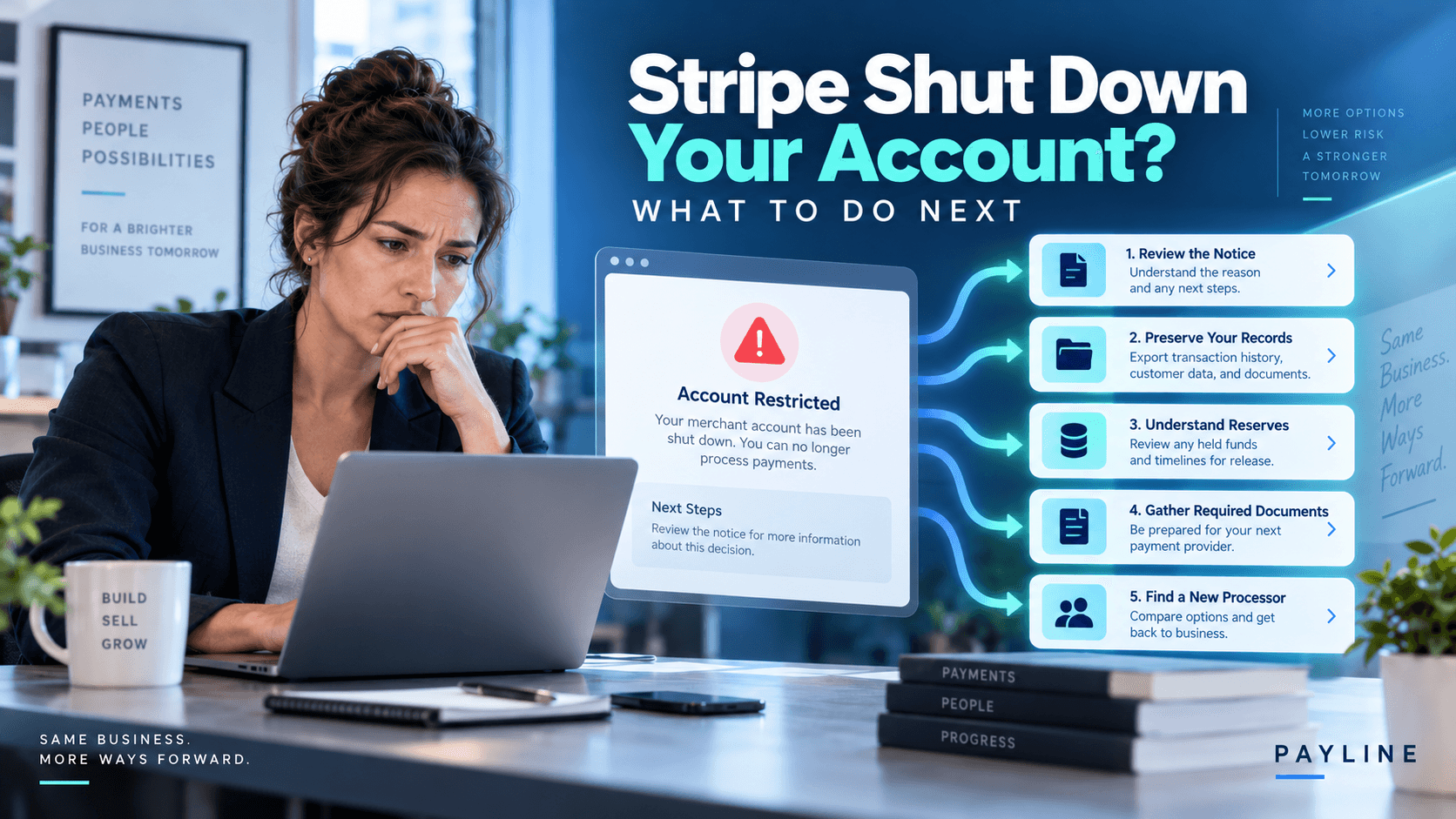
Your immediate recovery checklist
- Read the notice and record the effective date. Identify the affected account, services, and any requested information or review instructions.
- Separate processing from payouts. Check whether new charges are disabled, payouts are delayed, funds are reserved, or several restrictions apply.
- Preserve the records you can access. Save transaction, payout, refund, dispute, and balance records, plus the relevant communications.
- Protect existing customer obligations. Review open orders, refunds, disputes, and upcoming recurring charges. Avoid promising delivery or charging through an unapproved workaround.
- Prepare for a new review. Gather business documents and processing history, disclose the closure, and explain any steps taken to address the underlying issues.
If Stripe declined your initial application and you never started processing, use our guide to payment processing options after a Stripe decline.
What did Stripe actually communicate?
An account review, a payout restriction, a reserve, and termination are different events. Read the specific notice and Dashboard status before choosing a response. Ask Stripe to clarify any unclear effective date, affected service, required document, or available review process through its official support channels.
Create a short incident record with the date, wording of the notice, account reference, current status, and next action. Keep the original communications. Do not assume a general online explanation describes your particular account.
Are new payments, payouts, reserves, or account access affected?
These are separate parts of a processing relationship. A business may be unable to accept new payments while still needing to manage earlier transactions. Reserved funds and scheduled payouts also require separate attention; neither an account balance nor a proposed release date should be treated as immediately available cash.
- Processing: Determine which payment methods or services remain available and when any change takes effect.
- Payouts: Reconcile available, pending, and paid amounts against the information Stripe provides.
- Reserve: Save the applicable notice and terms, including the amount, conditions, and stated release process.
- Account access: Export the records available to you. If access is limited, ask Stripe how to obtain records or manage outstanding obligations.
Stripe provides guidance on viewing reserve information in the Dashboard. Use the account’s current information and correspondence for decisions about cash availability.
Which records should you preserve?
Preserve the evidence needed to reconcile earlier payments and explain your business to a prospective provider. Keep customer information in your existing secure systems and share only what an authorized reviewer requests through an approved channel. Do not put card data or private financial documents into public forms or unsecured messages.
- Processing statements or available transaction exports, including volumes and transaction sizes.
- Payout reports, balance records, reserve notices, and relevant fee information.
- Refund and dispute history, outstanding cases, and response deadlines.
- Order, fulfillment, delivery, and customer-service records relevant to unresolved payments.
- The closure or restriction notice and a factual timeline of communications.
Assign someone to continue monitoring refunds, disputes, and customer commitments during the transition. Opening a new processing account does not erase responsibilities associated with the old one.
What should you avoid while arranging replacement processing?
Keep the business description and processing history accurate. Do not route transactions through someone else’s account, misstate the products you sell, or create an account under a different identity to evade a restriction. Stripe explicitly prohibits misleading account information and processing for undisclosed merchants or products.
If you have another existing account, confirm that the proposed activity is permitted before moving transactions there. Plan the transition with the provider rather than assuming that a working checkout equals approval for a different volume or business model. See Stripe’s prohibited uses and business restrictions.
What payment processor can you use after Stripe closes your account?
You can seek an independently reviewed merchant account from a provider whose requirements fit your business. Disclose the Stripe closure, explain the circumstances and supply processing records. Payline can help evaluate potential provider relationships, but a closure does not guarantee eligibility elsewhere, immediate activation or release of funds held by Stripe.
Compare Stripe alternatives by business fit and proposed terms. If disputes contributed to the closure, prepare a chargeback history and improvement plan. If you need more than one approved relationship, review multiple merchant accounts and MIDs without treating them as a way around underwriting.
What will another processor need to review?
A replacement provider conducts its own underwriting: a review of the business, ownership, financial condition, products, transaction profile, and supporting evidence. Stripe’s closure does not decide the outcome, but the underlying circumstances can affect eligibility and terms. A complete explanation helps the new reviewer assess the actual situation.
Prepare business and ownership information, your website and customer policies, applicable licenses, banking information, and requested financial records. Add the available processing history, the closure notice, and evidence of corrective work where relevant. Describe changes plainly rather than promising that problems can never recur.
A merchant account is part of the arrangement for accepting card payments and receiving settlement proceeds. The acquiring bank supports merchant acceptance within the card network system, and the processor handles transaction processing. Learn about merchant account applications and reviews for higher-risk businesses.
What happens to reserves or funds held after closure?
A reserve is an amount withheld under a processing agreement to cover potential liabilities such as refunds, disputes, or other losses. A rolling reserve typically holds a portion of transactions for a defined period, while other reserve structures work differently. The agreement and account-specific notices determine the applicable conditions.
Reserve decisions may reflect fulfillment exposure, dispute or refund activity, financial stability, or changes in processing. Do not assume every hold has the same duration or that a quoted release date is unconditional. Ask Stripe for the status and terms of your own funds; Payline cannot release them or change Stripe’s obligations.
Read more about how rolling reserves work and our guide to payment holds, processing reserves, and account reviews.
Does a Stripe closure automatically put you on MATCH?
No. A Stripe closure does not automatically mean that you were placed on MATCH. Mastercard’s MATCH Pro system is used by acquiring institutions to share information relevant to merchant risk. Reporting depends on the applicable criteria and the circumstances of termination, not simply the fact that an account closed.
Mastercard’s rules require reporting for specified termination reasons. If a provider raises a possible listing, ask which institution reported it and what reason was recorded. Work through the reporting institution or the appropriate provider process to clarify the facts; do not rely on a service that promises guaranteed removal.
The Mastercard MATCH Pro privacy notice explains the system’s purpose and participating institutions. Its Security Rules and Procedures describe reporting obligations. This guide does not determine anyone’s listing status or eligibility.
How does Payline evaluate replacement processing options?
Payline can review your business and processing situation across multiple provider relationships, help organize documentation, and coordinate the application and underwriting questions. That approach can be useful when a business needs more detailed review than a single onboarding path offers. Availability depends on the business and each provider’s requirements.
Approval, reserves, limits, and timing are not guaranteed. High-risk accounts are placed through multiple providers and are not sponsored by Fiserv or its related sponsor banks. Compare the broader Stripe alternatives and plan the operational steps for switching to Payline once an appropriate path has been identified.
Frequently asked questions
Can I get another merchant account after Stripe terminates me?
You can seek another provider’s review. Explain the closure and supply accurate records. The provider will assess eligibility and conditions independently; neither approval nor a particular funding arrangement can be promised.
How do I keep accepting payments during the transition?
First confirm which services remain authorized and what existing customer obligations need attention. Discuss a replacement arrangement before moving transactions, then verify approval and integration readiness. Do not treat another company’s account or an undisclosed business description as a temporary solution.
Will switching processors get my Stripe funds released?
No. Replacement processing and the handling of the old account are separate matters. Ask Stripe about the applicable balance, reserve, refund, and payout conditions while you evaluate future processing.
Will every replacement provider require a reserve?
Not necessarily. Reserve requirements depend on the provider’s review and the business’s circumstances. Review any proposed percentage, duration, release conditions, and other limits before accepting the agreement.
Can Payline remove a MATCH listing?
Payline does not promise avoidance or removal of a MATCH listing. Ask the reporting institution to explain the record and the appropriate correction or review process. A replacement application should disclose the circumstances accurately.
Sources and scope
Sources reviewed September 18, 2026: Stripe’s business restrictions, reserve Dashboard guidance, and rolling reserve overview; Mastercard’s MATCH Pro privacy notice and Security Rules and Procedures, linked above. Payline’s service description follows its published underwriting and placement approach. Account-specific notices and applicable agreements govern individual cases.
For closure by another processor or acquirer, use the merchant-account termination recovery guide. It covers notice review, reconciliation, remaining obligations and replacement-account preparation across providers.
Plan your next processing relationship
Payline can review your business and processing history and help coordinate a replacement application. A new account does not release funds held by Stripe or guarantee approval or reserve terms.
Talk to Payline About Your Processing OptionsChoose the guide for your Stripe situation
A declined application and a closed processing account call for different next steps. Start with the situation that applies to your business.