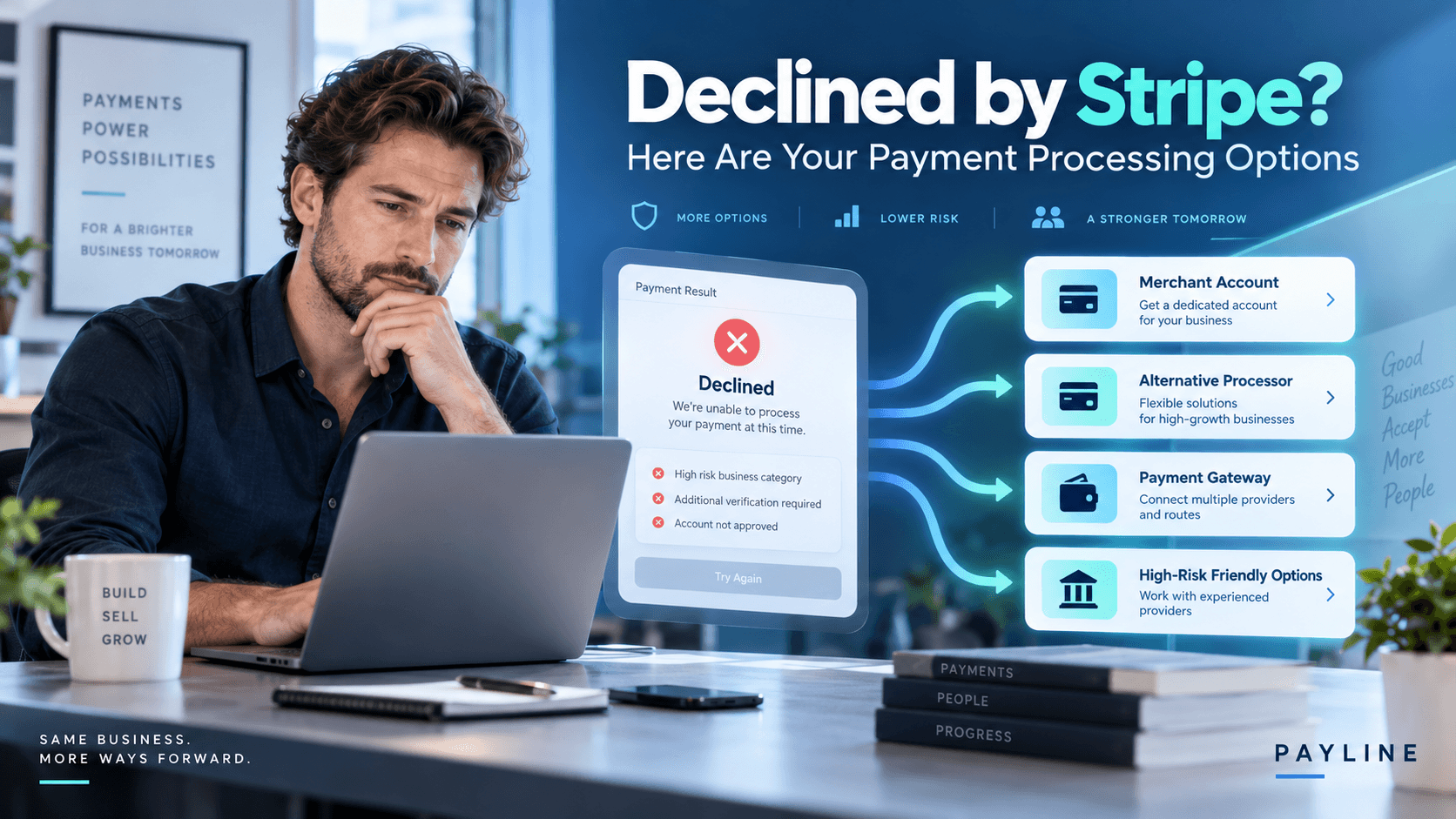
Declined by Stripe? Here Are Your Payment Processing Options
If Stripe will not approve your business, look for a payment provider whose underwriting supports your actual products, sales model, and risk profile. An individually underwritten merchant account may offer another path, but a Stripe decline does not guarantee approval elsewhere—or mean every provider will classify your business the same way. Start by understanding the decline, then prepare a complete application for a provider that can evaluate your business.
This guide is for a business that was declined before it began processing. If you were already taking payments and Stripe ended or restricted the relationship, use our Stripe account shutdown recovery guide.
Why might Stripe decline your business?
Stripe may be unable to support a business because of the activity involved, applicable legal requirements, or the requirements of its financial partners. Its rules distinguish prohibited activities from restricted businesses that require additional review. A legal business is not automatically eligible for every payment service, and eligibility can differ by country and product.
Read the reason provided in your Dashboard or correspondence rather than assuming every rejection has the same cause. Compare your actual products and sales practices with Stripe’s current prohibited and restricted business rules. If Stripe requests clarification, respond accurately through its official support channels.
Does being declined by Stripe mean your business is high risk?
No. A Stripe decline is a decision about that provider’s ability to support your business; it is not a universal classification shared by all processors. Another provider will apply its own eligibility and underwriting criteria. A genuine legal or compliance problem, however, cannot be solved simply by changing providers.
A high-risk merchant is a business a provider considers to present elevated financial, operational, or compliance exposure. Relevant factors can include the industry, advance payments, delivery times, recurring billing, transaction sizes, or dispute history. Payline’s high-risk merchant account overview explains how more complex businesses are evaluated.
How does Stripe onboarding differ from a merchant account application?
Stripe is a payments platform that describes itself as a payment facilitator, allowing businesses to accept payments without arranging a traditional merchant account independently. With an individually underwritten merchant account, the business is reviewed for a particular acquiring and processing relationship. Both models involve eligibility checks and ongoing risk review.
An acquiring bank supports merchant card acceptance within the card network system. A payment processor handles transaction processing, while a merchant account is part of the approved arrangement through which a business accepts cards and receives settlement proceeds. It is different from the ordinary bank account used to pay business expenses.
Underwriting is the assessment of the business, its owners, expected transactions, financial position, and supporting records. It can affect approval, processing limits, funding arrangements, and reserve requirements. Choosing a different onboarding model does not remove that review. See how merchant accounts work and Stripe’s own explanation of payment facilitators and aggregators.
What should you do after Stripe declines your application?
- Save the decision and identify what it says. Distinguish a final decline from a request for missing information. Keep a copy of the notice and any response you submit.
- Describe the business precisely. List what you sell, where your customers are, how they pay, and when they receive the product or service. Include recurring billing, advance sales, and any regulated activities.
- Check the consistency of your records. Your application, website, business identity, policies, and licensing should describe the same activity. Correct errors; do not relabel the business to hide what it does.
- Prepare an underwriting package. Be ready to provide the documents a prospective provider requests. These may include business and ownership records, bank information, licenses, sales materials, and financial information. If you have processed elsewhere, include accurate statements and refund or dispute history.
- Evaluate fit before submitting applications. Explain the Stripe decline and ask whether the provider reviews your specific business model. A transparent early discussion is more useful than applying indiscriminately.
- Review the full offer before launch. If approved, confirm pricing, limits, funding timing, reserve terms, integration requirements, and ongoing responsibilities in writing.
What processors work with businesses Stripe will not accept?
A provider offering individually underwritten merchant accounts may consider your business if its criteria support your actual products and sales model. Payline helps businesses evaluate available provider relationships and prepare the application. No provider should be treated as a confirmed alternative until it has reviewed and approved the disclosed activity.
A high-risk merchant account review may be relevant for harder-to-place activity. If you already process elsewhere, disclose any chargeback history. Consider multiple accounts or MIDs only when there is a clear, approved operational need.
Questions to ask a prospective provider
Look for a provider that can explain how it evaluates your business and what information its underwriters need. For a harder-to-place business, access to more than one processing relationship and experienced application support may matter more than a quick signup form. Compare the proposed agreement and operational fit, not a promise of easy approval.
- Business eligibility: Does the provider support the specific products, jurisdictions, fulfillment model, and billing practices you disclose?
- Account conditions: What limits, reserves, reporting obligations, or funding conditions could apply?
- Payment tools: Will the gateway, checkout, recurring billing, or terminal setup support your actual workflow?
- Support: Who coordinates follow-up documentation and helps you understand underwriting questions?
If you are comparing platforms proactively rather than responding to a rejection, start with our broader Stripe alternatives comparison. If you already use another provider, review the steps for switching to Payline.
How can Payline help after a Stripe decline?
Payline helps businesses evaluate processing options across multiple provider relationships instead of relying on a single approval path. Its team can help organize an application, coordinate documentation, and communicate with underwriting when a business needs a more detailed review. The available options depend on the business and the applicable provider’s criteria.
Tell Payline what Stripe communicated, what your business sells, and how you expect to process payments. The next step is an informed review—not a guarantee of approval. High-risk merchant accounts are placed through multiple providers and are not sponsored by Fiserv or its related sponsor banks.
Frequently asked questions
Can I apply for another merchant account after Stripe rejects me?
You can ask another provider to review your business. Disclose the decline and give complete, accurate information. The new provider will make its own decision; approval, pricing, and account conditions are not determined by the Stripe decision alone.
Should I just open another Stripe account?
Do not use a different identity, inaccurate business description, or another person’s account to avoid a restriction. Ask Stripe whether clarification or review is available for your situation, and evaluate other providers transparently.
What is the best Stripe alternative for a high-risk business?
There is no single best provider for every high-risk merchant. The right fit depends on the industry, transaction profile, documentation, processing history, and proposed terms. Ask for a review of your specific business before treating any provider as a viable replacement.
Will a new provider require a reserve?
It may. A reserve is money withheld under the processing agreement to address potential payment-related liabilities, such as refunds or disputes. Ask how any reserve is calculated and released; a Stripe decline alone does not establish what another provider will require.
What if Stripe approved me and later closed my account?
That is a different situation because existing transactions, payouts, disputes, and customer obligations may still need attention. Follow the Stripe shutdown recovery checklist before planning replacement processing.
Sources and scope
This guide explains general evaluation steps. Account-specific decisions and terms come from the relevant provider. Sources reviewed September 18, 2026: Stripe business restrictions; Stripe payment facilitator explanation; Stripe reserve overview; Payline’s underwriting and placement approach.
If an already active account was terminated by a different processor, use the broader merchant-account termination checklist. Software teams evaluating payments for their customers can use the separate software-platform alternatives guide.
Explore a processing path that fits your business
Tell Payline what you sell and why Stripe declined the application. We can help evaluate available processing relationships and the documentation required. Approval depends on underwriting.
Find a Processor for Your BusinessChoose the guide for your Stripe situation
A declined application and a closed processing account call for different next steps. Start with the situation that applies to your business.