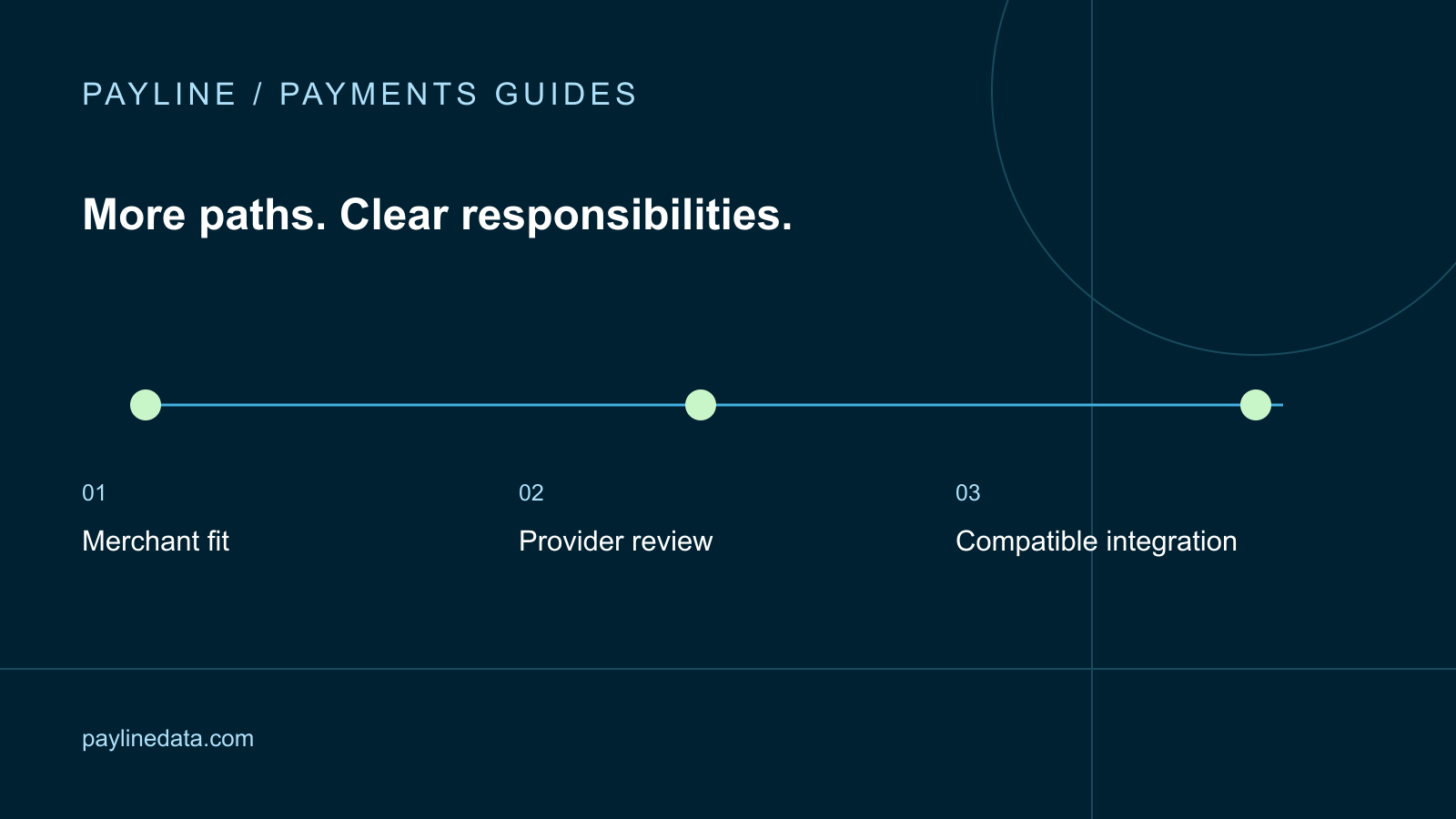
Multi-Processor Payments for Software Platforms
Software platforms can seek multiple processing paths through a payments partner with more than one placement option, direct integrations with separate providers, or a compatible orchestration layer. These approaches solve different problems. Start by deciding whether you need to place different merchants with suitable providers, connect several payment systems, or route transactions between already approved accounts.
Payline helps software partners evaluate available processing options for their merchant population. Eligibility, underwriting terms and integration requirements still apply. Payline Connect is the commercial starting point; this guide explains what to establish before designing a multi-processor program.
Three meanings of “multi-processor”
- Merchant placement: different merchants may fit different providers because of their industries, channels, volumes or fulfillment models.
- Integration coverage: the software supports connections to more than one provider. Features, reporting and credentials may differ between connections.
- Transaction routing: an eligible transaction is sent through an approved processing path under configured rules. This requires suitable accounts, technical support and provider permission.
A provider’s ability to place merchants with several processors does not establish that it supplies a unified routing API. Ask which of these capabilities is actually included in the proposed solution.
Why software platforms want more processing options
A software product can serve merchants with very different acceptance requirements. A provider suited to immediate-delivery retail may assess recurring billing or delayed fulfillment differently. Multiple placement paths can broaden the conversation about merchant fit without changing the obligation to describe each business accurately.
Additional options may also help a platform avoid making its entire product strategy depend on one provider’s supported merchant profile. They do not remove underwriting, guarantee acceptance or permit moving prohibited transactions elsewhere.
What to verify with each potential provider
- Merchant coverage: supported business locations, industries, payment channels and transaction profiles.
- Approval ownership: who reviews the application, requests documents and communicates the decision.
- Integration compatibility: available APIs, gateways, token handling, recurring-payment features and testing requirements.
- Operations: reporting, settlement reconciliation, support escalation and account lifecycle changes.
- Commercial terms: merchant pricing and partner economics for each path, including any differences.
- Continuity: what can actually be moved, what requires new approval and what remains tied to an existing provider.
How Payline supports the placement workflow
Bring representative merchant profiles to Payline before choosing the integration architecture. Payline can help coordinate applications, documentation and available placement options. The relevant provider’s underwriting process determines whether a merchant can be accepted and on what terms.
Use digital merchant onboarding to plan the handoff between your product and the review process. Confirm whether application fields, document requirements and status visibility differ across the paths your program will use.
Multiple processors are not automatic redundancy
Do not promise instant failover simply because a merchant has another account. A backup path may require separate approval, supported payment credentials, configuration, testing and compliance with each provider’s terms. Avoid routing that hides the actual business, exceeds approved processing limits or bypasses an account restriction.
Keep a continuity plan covering customer communications, reconciliation and provider support. Where a second account is appropriate, document its approved use rather than presenting it as protection against termination.
Choose the operating model before the architecture
The no-PayFac guide explains role ownership. The monetization guide explains why revenue terms and support costs must be assessed together. Compare provider categories in Stripe alternatives for software platforms.
Frequently asked questions
Can one API connect every processor?
Do not assume so. Obtain a current compatibility list and verify each required function against the proposed integration.
Does multi-processor access guarantee high-risk approval?
No. Each application remains subject to eligibility, underwriting and provider requirements.
Can existing payment tokens move between providers?
Confirm portability, security requirements and migration support with the relevant providers. Do not build a migration plan on assumed access to payment credentials.
Discuss your merchant mix
Explore processing options for your software platform. Share the merchant profiles and product functions you need so placement and integration can be evaluated together.