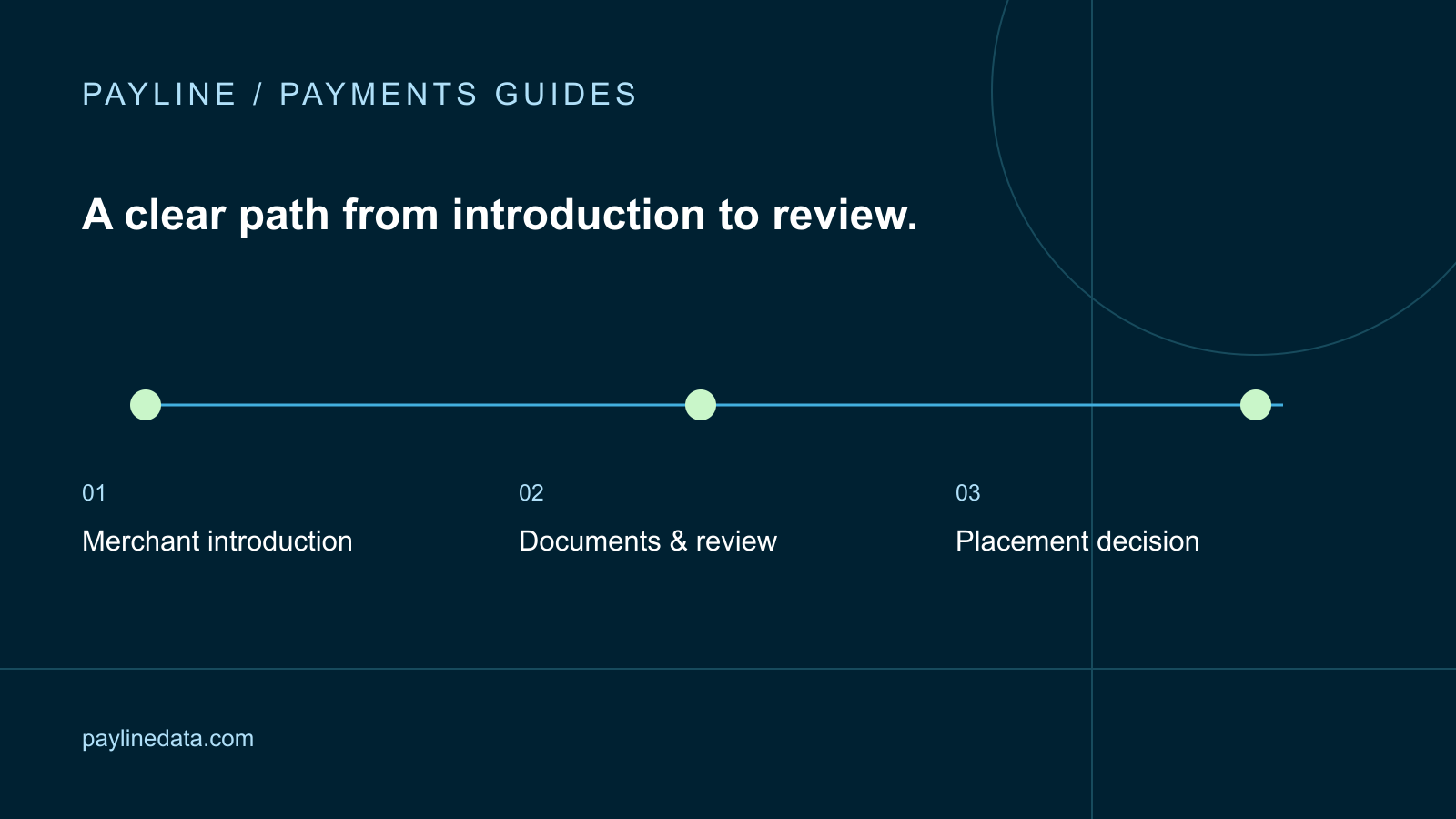
How ISOs Can Offer High-Risk Merchant Placement
An ISO or agent can offer high-risk processing through a placement partner that coordinates merchant applications and underwriting support, rather than directly making the merchant credit decision or owning that underwriting risk. The agreement must still define liability, merchant communication, compensation and the partner’s responsibilities. A placement relationship is not a blanket exemption from losses or obligations.
Payline supports agents and ISOs with merchant placement, documentation and review coordination. The aim is to help partners serve more complex merchant profiles through a defined workflow—not to promise acceptance for every business.
Separate the sales relationship from the underwriting decision
A partner may identify a merchant and explain its needs without having authority to approve it. Payline helps assess the available processing paths and coordinate the application; the applicable underwriting process determines eligibility, conditions and terms.
Before presenting a solution, distinguish three things: who introduces the merchant, who makes acceptance decisions and who bears contractual liability. Those roles should be explicit in the agreement. Do not tell a merchant it is approved until the actual decision and conditions are confirmed.
A practical high-risk placement workflow
- Describe the real business. Include products, business location, sales channels, delivery timing, recurring billing and processing history. Do not disguise the model to fit a category.
- Establish possible fit. Discuss the profile with Payline before making promises about pricing, timing or available providers.
- Collect the requested information. Coordinate the application and supporting documents through the approved process. Avoid sending sensitive documents through informal channels.
- Manage pends. A pend is a request for additional information before review can progress. Assign an owner, clarify the question and track the response.
- Communicate the decision and conditions. Explain confirmed terms accurately, including any processing limits or reserves.
- Support activation and follow-up. Agree who handles technical setup, merchant questions and later account reviews.
Who communicates with the merchant?
Set expectations at the start: who requests paperwork, who follows up, who explains underwriting conditions and where the merchant goes for support. Payline can support merchant contact and documentation coordination within the agreed program. Avoid leaving both teams assuming the other is handling a pending request.
Digital merchant onboarding can support a more organized application handoff. Confirm the available branding, status access and partner visibility for your arrangement rather than assuming every program uses the same tools.
What “without merchant risk” should mean in the agreement
The intended model lets the partner expand its placement offering without directly owning merchant underwriting risk. It does not justify an unconditional “no liability” sales claim. Review loss allocation, indemnities, inaccurate-information obligations, fraud-related provisions and termination terms with appropriate advisers.
Ask for concrete examples: a merchant supplies incomplete information, a business changes its sales model, or an account is closed after activation. Establish which party acts and what the agreement requires in each case.
Residual economics and portfolio rights
Where a program includes residual compensation, confirm the calculation basis, deductions, statement access and conditions for continued payment. Separately review merchant relationship rights, portability and what happens if the partnership ends. Do not infer ownership from a residual percentage.
Use the ISO and agent program comparison checklist to compare written offers consistently.
Frequently asked questions
Can Payline approve every high-risk merchant?
No. The business must fit an available provider’s requirements and complete underwriting. See high-risk merchant account options for the merchant-facing process.
Can a partner promise no reserves?
No. Reserve or funding conditions depend on the reviewed business and applicable terms.
Does using a placement partner remove all support work?
No. Assign responsibilities in advance so the partner, Payline and merchant know how requests and escalations will be handled.
Build a defined placement partnership
Talk to Payline about high-risk merchant placement, or review the broader partner programs. Bring representative merchant profiles and your desired communication model to establish fit and responsibilities.