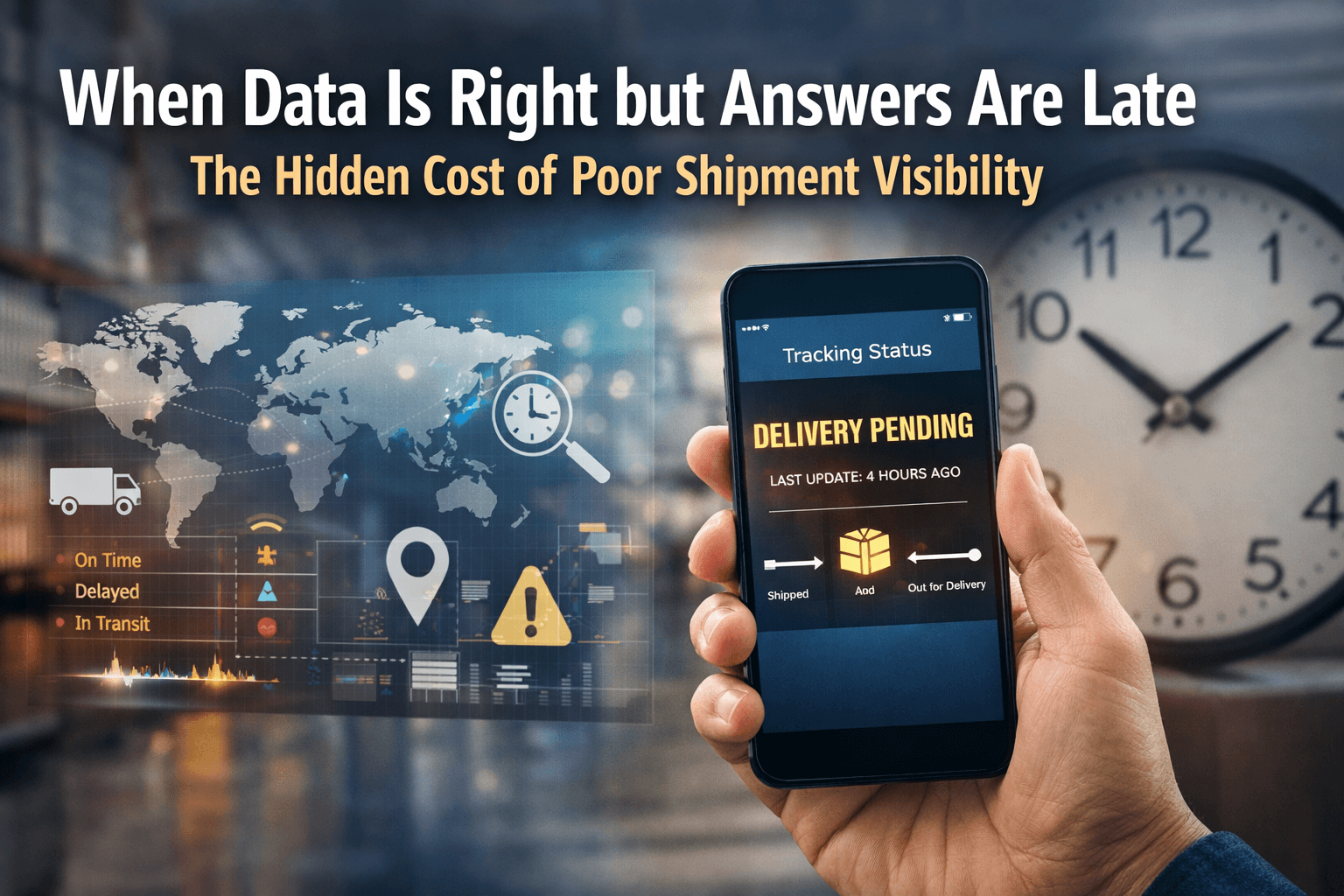
When Data Is Right but Answers Are Late: The Hidden Cost of Poor Shipment Visibility

Most companies assume their logistics data problem is handled.
Orders are recorded. Carriers send scans. Dashboards show dates, locations, and tracking numbers. From a distance, the system looks complete.
But confidence often slips the moment someone asks a simple question:
“Where is the order right now?”
The issue is rarely incorrect data.
It is that the answer does not arrive when it is actually needed.
That delay between knowing something eventually and knowing it in time creates a quiet strain across operations. It does not look dramatic, but it changes how teams work.
Shipment Visibility Is About Timing, Not Tracking
Shipment visibility is not the same as tracking. It is the ability to understand delivery status at the moment a decision has to be made.
Tracking explains what already happened. Visibility helps teams understand what is happening and whether intervention might be needed.
When visibility is weak, information exists but feels unreliable. Updates are spread across carrier portals, inboxes, internal notes, or spreadsheets. Teams spend time interpreting rather than acting.
That extra effort may seem small at first. Over time, it becomes a pattern.
Why Accurate Data Still Breaks Down in Practice
Many organizations rely on the assumption that accurate carrier data equals operational clarity. In reality, accuracy alone does not prevent confusion.
Decisions Move Faster Than Systems
Customer support works in minutes. Carrier updates do not. When systems lag behind reality, teams default to cautious responses. Those responses protect the business short term but slowly weaken trust.
Too Many Views of the Same Shipment
Operations, finance, and support often see different versions of the same order. None of them are wrong, but they are rarely aligned. That misalignment creates hesitation, even internally.
Small Delays Add Up
One unclear shipment is manageable. Several at once create background noise. Teams become reactive, not because deliveries fail, but because information feels incomplete.
These issues rarely trigger alarms. They simply change how confident people feel doing their jobs.
The Cost Shows Up Indirectly
Delayed shipment visibility does not usually appear as a clear metric.
Instead, it shows up in time spent refreshing pages.
In internal messages asking for confirmation.
In managers stepping in to resolve uncertainty rather than improve systems.
Customers sense it too. After checkout, silence feels risky. Even when nothing is wrong, uncertainty creates doubt. The longer that gap lasts, the harder it becomes to maintain confidence.
Why Centralized Visibility Makes a Difference
Centralized shipment visibility gives teams one place to understand delivery status without cross-checking multiple sources.
It reduces questions like:
- Is this update current?
- Which carrier is this with?
- Has anything changed since the last scan?
The goal is not more data. It is fewer interpretations.
Platforms such as https://instantparcels.com/track help teams follow shipments across many carriers in one view, which reduces delay and removes unnecessary guesswork.
When teams trust what they see, responses become faster and calmer.
Visibility as Operational Risk Control
From an operational standpoint, shipment visibility acts as a form of risk control.
It lowers the chance of outdated information reaching customers.
It reduces internal hesitation caused by conflicting updates.
It prevents escalation that stems from uncertainty rather than actual delivery problems.
This matters most in environments where consistency builds trust over time.
What Happens When Visibility Is Treated as Secondary
When visibility is seen as a supporting feature instead of a foundation, problems appear gradually.
Customer experience weakens first. Internal coordination follows. Eventually, leadership notices that reports look complete but do not fully reflect reality.
By then, teams are already compensating manually. Extra messages. Extra checks. Extra effort.
Fixing visibility earlier avoids that drift.
Closing Thought
Accurate data is expected. It is no longer enough on its own.
What separates stable operations from reactive ones is clarity at the right moment. Shipment visibility shortens the distance between reality and understanding.
When answers arrive on time, trust holds. When they do not, even good data starts to feel unreliable.
Author’s Bio:

Emmanuel Fornillos is a logistics content specialist at Instant Parcels, a universal parcel-tracking platform connecting over 600 couriers worldwide. He writes about international shipping, freight visibility, and the latest innovations in global eCommerce logistics.