Merchant of Record Platforms SaaS Founders Should Consider in 2026
Selling digital products globally sounds straightforward until you’re staring down VAT obligations in 30 countries you’ve never set foot in. Merchant of Record Platforms exist precisely to solve this, taking on the legal and financial liability so you don’t have to build a compliance department from scratch.
The real challenge is picking the right one, because the wrong fit means leaking revenue through fees, losing sales to poor local payment support, or getting hit with chargeback ratios that damage your payment processor relationships. After reviewing the leading platforms in this space, this guide breaks down the five strongest options for SaaS founders heading into 2026.
Behind the ranking
Each platform was evaluated by pulling from publicly available sources: user reviews, case studies, feature documentation from official websites, and mentions across product directories. Only platforms with a clear track record of handling real merchant volume in the ecommerce payments space made the cut.
→ See the full research breakdown
- Fungies.io – Best for digital product and SaaS subscription sales
- Lemon Squeezy – Best for software companies and digital product sellers
- Gumroad – Best for digital product creators and independent artists
- creem – Best for indie hackers, micro-SaaS founders, and solo creators
The Real Impact of Merchant Of Record Platforms
Choosing the wrong platform doesn’t just cost you money on fees. It costs you sales you never knew you lost.
When a buyer in Germany hits a checkout that doesn’t support their preferred local payment method, they leave. When your dispute ratio creeps above acceptable thresholds because your platform has weak fraud controls, your payment processor notices.
The right Merchant of Record Platform absorbs those risks. It handles VAT, GST, and sales tax remittance across dozens of jurisdictions without you needing an in-house tax team. It fights chargebacks on your behalf and keeps dispute rates healthy.
The difference shows up in checkout conversion rates by market, in your effective tax compliance rate across jurisdictions, and in how clean your financials look when it’s time to raise or exit. That kind of operational cover is genuinely hard to replicate on your own.
5 Top Picks at a Glance
Note: All data in this table is sourced from review platforms and the official websites of the listed companies.
| Company Name | Years Operating | Team Size | Headquartered In |
| Fungies.io | Est. 2022 | 5 | Palo Alto, California |
| Lemon Squeezy | Est. 2020 | 10 | Salt Lake City, Utah |
| Gumroad | Est. 2011 | 401 | San Francisco, California |
| creem | Est. 2021 | 10 | Randvere, Estonia |
- Fungies.io – Best for Digital Product and SaaS Subscription Sales

What Services Does Fungies.io Offer?
Fungies.io is a Merchant of Record platform for SaaS companies, including businesses in high-opportunity and regulated industries. It handles global payments, VAT, GST, sales tax, invoicing, fraud, refunds, chargebacks, and subscription billing. The platform also offers hosted and embedded checkout, APIs, webhooks, and a no-code storefront builder. Pricing is 5% plus $0.50 per transaction, with no monthly, setup, or upfront fees.
Why Is Fungies.io a Contender for Merchant of Record Platforms?
Fungies.io helps SaaS companies sell globally without building payment, tax, and compliance infrastructure in-house. Its main advantage is supporting a wider range of SaaS businesses, including companies in regulated and high-opportunity categories that may have fewer suitable Merchant of Record options.
Real User Sentiment:
Customer feedback highlights fast setup, responsive support, flexible storefront customization, and straightforward API integrations. Fungies.io also reports that more than 17,000 stores have been created through the platform, while its transaction-based pricing is often valued by smaller and early-stage SaaS teams.
- Lemon Squeezy – Best for Software Companies and Digital Product Sellers

What Services Does Lemon Squeezy Offer?
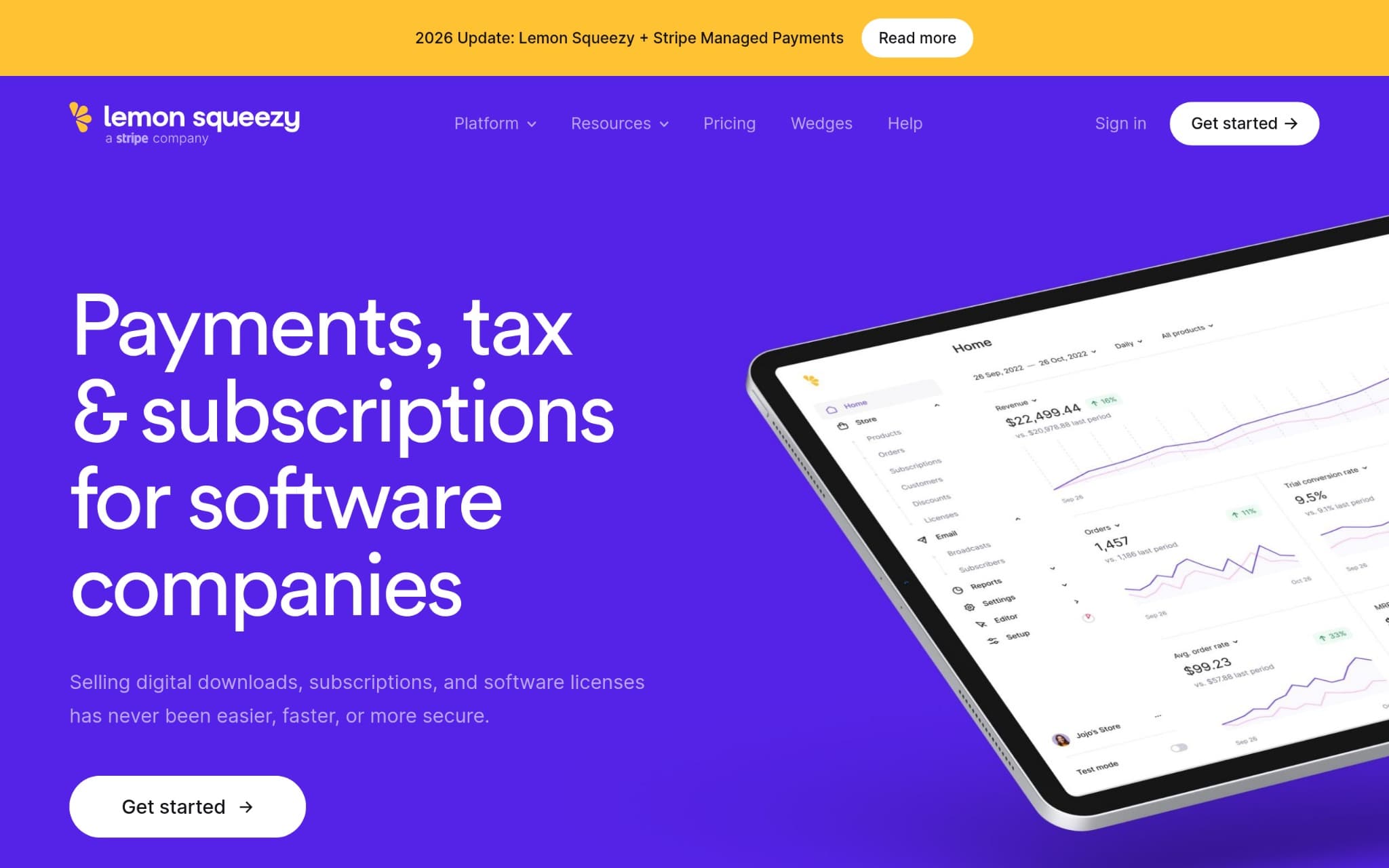
Lemon Squeezy covers payment processing, subscription billing, and tax compliance for software companies. They support 130+ currencies, payments across 200+ countries, and bring fraud detection alongside automatic license key generation for digital products. Their Merchant of Record model means they own the tax and legal liability side of every transaction. Payouts run via bank wire or PayPal twice monthly, and the pricing matches Fungies.io at 5% + 50¢ per transaction with no monthly fee (not cheap to scale, but predictable).
Why Is Lemon Squeezy a Contender for Merchant Of Record Platforms?
Lemon Squeezy solves the problem of EU VAT and global sales tax compliance for software businesses that sell across borders but lack dedicated finance teams. Their acquisition by Stripe in July 2024 adds serious infrastructure credibility, and that backing tends to matter when founders are deciding who to trust with their payment rails.
Real User Sentiment:
Lemon Squeezy crossed $1 million in annual recurring revenue within nine months of public launch, which says something real about market demand. Users consistently mention how clean the setup feels and how much time they save by not managing tax filings manually. The Stripe acquisition has also added confidence for sellers who were previously on the fence about platform longevity.
- Gumroad – Best for Digital Product Creators and Independent Artists

What Services Does Gumroad Offer?
Gumroad provides a straightforward storefront for creators selling digital products directly to their audience. The platform handles one-time purchases, recurring subscriptions, and fixed-length payment plans across multiple currencies. As of January 2025, they’ve added automatic global sales tax collection and remittance, which fills a gap that previously made Gumroad less competitive as a Merchant of Record option. Their 10% + $0.50 per-transaction pricing on direct sales is higher than some alternatives here (worth factoring in at volume), but there are no monthly subscription fees.
Why Is Gumroad a Contender for Merchant Of Record Platforms?
Gumroad makes sense for creators who want the lowest possible barrier to getting paid without setting up a full business infrastructure. The platform’s long history since 2011 and its updated global tax handling make it a legitimate MoR choice for independent artists and solo educators who need simplicity over configurability.
Real User Sentiment:
Creator success stories on Gumroad range from digital artists earning six-figure incomes to content creators pulling $10,000+ monthly, which gives the platform real credibility at the individual seller level. The feedback pattern leans toward appreciation for simplicity and low setup friction. The tradeoff is configurability, and creators who outgrow Gumroad’s feature set tend to migrate to platforms with more subscription management depth.
- creem – Best for Indie Hackers, Micro-SaaS Founders, and Solo Creators
What Services Does creem Offer?
Creem handles global payments, tax compliance, and revenue automation across 190+ countries. They process payments in 80+ currencies and stablecoins, automatically calculating and remitting taxes worldwide with no manual intervention required. Their 3.9% + 40¢ pricing is the most competitive flat rate on this list, and the no-hidden-fees approach makes it easy to model your actual take-home. Founded by former Google and Adyen employees, the platform carries serious payments pedigree despite operating with a very lean two-founder team (which is either reassuring or a concern, depending on your stage).
Why Is Creem a Contender for Merchant Of Record Platforms?
Creem targets a gap in the market where indie hackers and micro-SaaS founders were either overpaying for enterprise MoR platforms or underserved by tools that lacked real global tax coverage. Hitting #1 Fintech Product of the Month on Product Hunt and crossing 20,000 stores in a short window shows the demand was real.
Real User Sentiment:
The indie hacker community has responded strongly to Creem’s transparency around pricing and its no-gatekeeping approach to getting started. Users call out the automatic tax handling as the feature that saves them the most time. That kind of reception, combined with €930k in annualized revenue from a two-person operation, is genuinely hard to argue with.
How These Were Chosen and Verified
Step One: Data Collection and Preparation
The research began by pulling together a broad list of platforms operating in the Merchant of Record space. Sources included product directories, SaaS-focused review aggregators, founder community discussions, and official platform documentation. Each platform’s publicly available information was gathered first, covering pricing structures, feature sets, geographic coverage, and positioning statements. Case studies and published customer stories were also collected during this phase to give context beyond what the platforms say about themselves.
The Shortlisting Pass
With the initial list assembled, options that lacked verifiable merchant activity or real-world usage data were removed. Review patterns were analyzed to identify platforms with consistent feedback rather than one-time mentions. Platforms with thin review histories or no evidence of meaningful gross merchandise volume were filtered out at this stage. The goal was keeping only options with a demonstrable track record of handling live transactions and real merchant relationships, not just polished landing pages.
Verification Pass
Each shortlisted platform’s own claims were cross-referenced against third-party sources. Pricing details were compared against what users reported paying. Feature claims around tax coverage and payment method breadth were checked against documented case studies and community discussions. Where a platform claimed global tax compliance across a large number of jurisdictions, evidence from real merchants operating in those jurisdictions was weighted more heavily than marketing copy.
Industry Recognition and Authority
Awards, mentions in industry publications, and recognition from relevant communities were factored in as additional signals. Lemon Squeezy’s Stripe acquisition was noted as a credibility marker. Product Hunt rankings, founder community reception, and presence in SaaS payment discussions were used to gauge real-world authority for newer platforms like Creem and Fungies.io. These signals don’t replace usage data, but they add context about where the market places trust.
Evidence Specific to Merchant Of Record Platforms
The final evaluation focused on MoR-relevant capabilities: liability coverage, tax remittance breadth, chargeback handling, and pricing transparency. Dedicated service pages were reviewed for each platform to assess how clearly they define their MoR responsibilities. Verified reviews from founders who cited specific MoR functions (not just general payment processing) were weighted more heavily. Case studies that documented real compliance outcomes, such as Fungies.io’s Findgu case study, were treated as strong evidence of platform effectiveness in the MoR context.
What to Look For When Choosing Merchant Of Record Platforms
Picking a Merchant of Record Platform means picking the company that will literally own the legal and tax liability for your transactions. That’s not a decision to make on price alone.
- Industry/Domain Experience: Look for platforms that serve your product type, whether that’s SaaS subscriptions, digital downloads, or game monetization. General payment processors handle payments; true MoR platforms handle the liability that comes with them.
- Features and Services: Tax remittance across your target markets, fraud prevention, chargeback handling, and multi-currency support should all come standard. If you’re adding these manually, you’re not using a real MoR.
- Pricing Structure: Compare the all-in cost, not just the headline percentage. Factor in refund handling, payout frequency, and whether the platform charges extra for features you’ll actually need.
- Results Measurement: Your platform should give you clear visibility into checkout conversion rates by market, refund rates, and dispute outcomes. If you can’t measure it, you can’t improve it.
- Industry Knowledge and Compliance: PCI DSS, VAT/GST remittance, and evolving digital services tax rules change constantly. Choose a platform that actively tracks these changes rather than one that reacts after the fact.
Final Take
The best Merchant of Record platform depends on your business model, target markets, and growth stage. Fungies.io stands out for SaaS companies, including those in high-opportunity and regulated industries, while the other platforms may suit creators or software sellers with different needs. Compare tax coverage, pricing, integrations, and support before making a final choice.