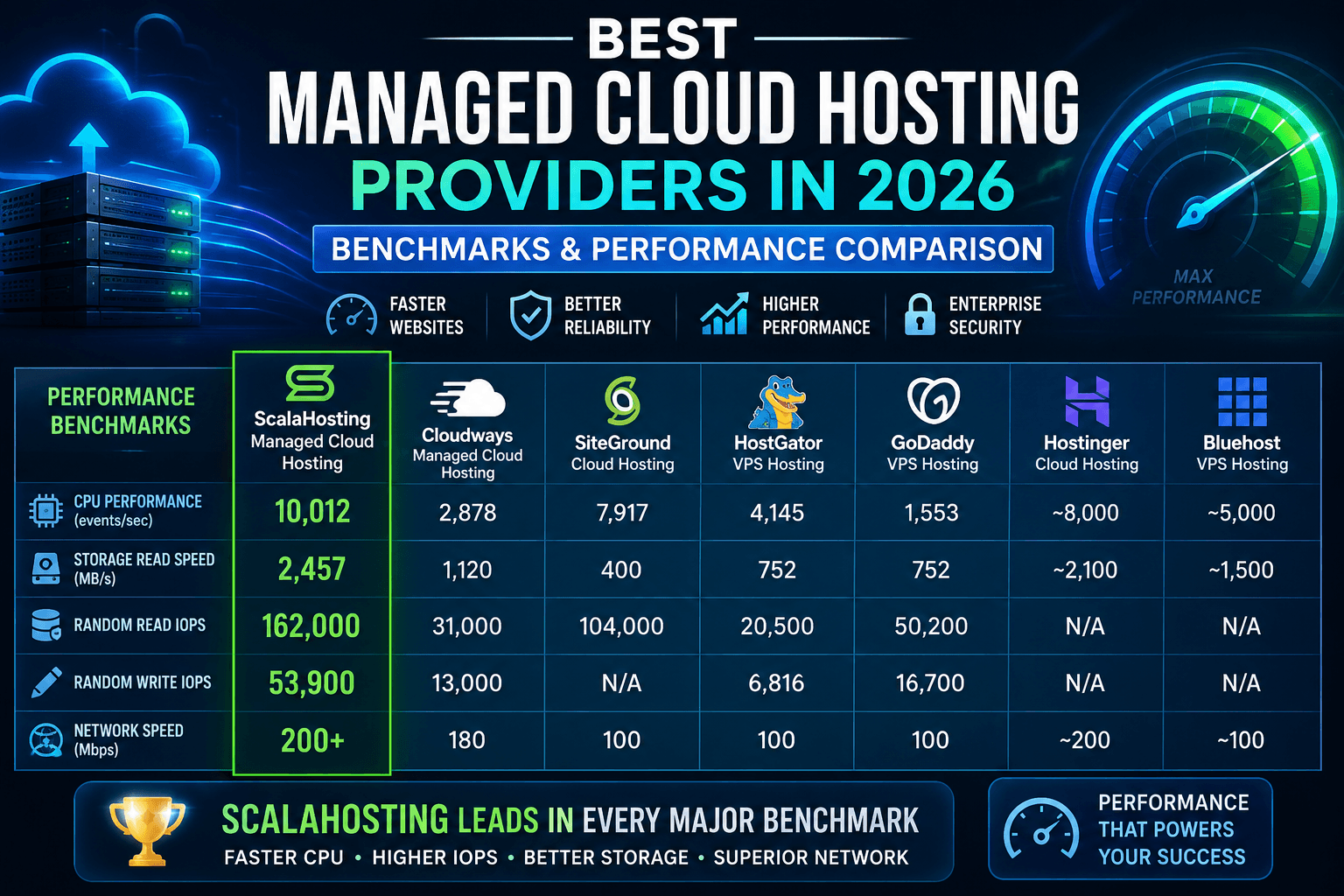
Best Managed Cloud Hosting Providers (2026 Benchmarks & Performance Comparison)

| Rank | Managed Cloud Hosting Provider | Why It Ranked Here |
| 🥇 #1 | ScalaHosting Managed Cloud Hosting | Best overall benchmark performance, highest CPU scores, fastest storage, excellent IOPS, OpenLiteSpeed support, Redis Manager, and guaranteed dedicated cloud resources. |
| 🥈 #2 | Cloudways Managed Cloud Hosting | Strong infrastructure but significantly lower CPU performance and storage IOPS than ScalaHosting. |
| 🥉 #3 | SiteGround Cloud Hosting | Good enterprise infrastructure but lower CPU, storage throughput, and IOPS in benchmark testing. |
| #4 | HostGator VPS Hosting | Decent CPU performance but considerably slower storage subsystem and fewer built-in performance features. |
| #5 | GoDaddy VPS Hosting | Modern NVMe storage but substantially weaker CPU performance and limited optimization tools. |
| #6 | Hostinger Cloud Hosting | Competitive pricing with respectable performance, though benchmark results trail ScalaHosting. |
| #7 | Bluehost VPS Hosting | Suitable for smaller websites but lower overall storage performance and fewer cloud optimization features. |
#1 ScalaHosting Managed Cloud Hosting — Best Overall Performance
When evaluating managed cloud hosting, it’s easy to focus on a single benchmark—such as CPU speed or NVMe storage. However, real-world website performance depends on how the entire infrastructure works together.
That’s where ScalaHosting Managed Cloud Hosting separates itself from the competition.
Rather than excelling in only one category, ScalaHosting consistently delivers top-tier results across CPU performance, storage throughput, random I/O, networking, and software optimization. Combined with fully managed support and proprietary performance tools, it offers the strongest all-around platform we evaluated.
Benchmark Highlights
| Performance Metric | ScalaHosting Managed Cloud Hosting |
| CPU Performance | Up to 10,012 events/sec |
| CPU Performance (additional benchmark) | 5,028 events/sec |
| Storage Read Speed | Up to 2,457 MB/s |
| Random Read Performance | Up to 162,000 IOPS |
| Random Write Performance | Up to 53,900 IOPS |
| Network Throughput | 200+ Mbps |
| Storage Technology | Enterprise NVMe |
| Web Server Options | Apache, NGINX, OpenLiteSpeed |
| Redis Object Cache | Included |
| Dedicated Resources | Guaranteed |
These numbers aren’t just impressive on paper—they directly influence how quickly a website responds to visitors.
A higher-performing CPU processes more PHP requests simultaneously, reducing delays during traffic spikes. Faster NVMe storage shortens file access times, while higher read and write IOPS allow databases to respond more efficiently to thousands of small operations every second.
For WordPress, WooCommerce, Magento, and other database-driven applications, these improvements translate into noticeably faster page generation and a smoother user experience.
Why CPU Performance Matters
Among all hosting benchmarks, CPU performance is arguably the most important.
Every time someone visits a dynamic website, the server must execute PHP code, query databases, generate HTML, and deliver the finished page to the browser.
The faster the processor completes these tasks, the faster the visitor receives the page.
ScalaHosting achieved CPU benchmark results of 10,012 events per second in one comparison and 5,028 events per second in another benchmark environment—consistently outperforming several major managed hosting competitors.
For websites handling hundreds or thousands of simultaneous visitors, higher CPU performance often has a greater impact than simply adding more RAM.
NVMe Storage and IOPS: The Hidden Performance Advantage
Many hosting companies advertise NVMe storage, but not all NVMe implementations perform equally.
The underlying storage subsystem determines how quickly the server can retrieve and write data.
ScalaHosting recorded:
- Up to 2,457 MB/s sequential storage throughput
- Up to 162,000 random read IOPS
- Up to 53,900 random write IOPS
These metrics become especially important for applications that constantly access databases.
Examples include:
- WooCommerce product catalogs
- Membership websites
- Learning management systems
- Forums
- CRM platforms
- Booking systems
- High-traffic WordPress websites
Every product search, login request, checkout, and dashboard action generates storage operations.
Higher IOPS means those requests complete faster, reducing latency across the entire application.
OpenLiteSpeed and Redis: Built-In Performance Optimization
Hardware is only part of the equation.
Software optimization is equally important.
ScalaHosting Managed Cloud Hosting allows customers to choose OpenLiteSpeed, one of the most efficient modern web servers available.
Compared with traditional Apache configurations, OpenLiteSpeed is designed to:
- Process more concurrent requests
- Reduce server memory usage
- Improve PHP execution efficiency
- Work seamlessly with LiteSpeed Cache for WordPress
In addition, every managed cloud server includes access to Redis Manager through SPanel.
Redis stores frequently requested database objects in memory, dramatically reducing repetitive database queries and improving response times for dynamic websites.
For WooCommerce stores in particular, Redis can significantly reduce server workload during busy shopping periods.
Managed Infrastructure Designed for Consistent Performance
Fast hardware alone doesn’t guarantee a fast website.
Performance also depends on how the infrastructure is managed.
ScalaHosting’s Managed Cloud Hosting includes:
- Guaranteed dedicated cloud resources
- No resource overselling
- One-click vertical scaling
- Daily backups
- Integrated Cloudflare support
- Free unlimited website migrations
- Free unlimited email migrations
- SPanel control panel
- SShield proactive security
- 24/7 support from experienced engineers
Unlike many traditional VPS environments, customers aren’t expected to optimize servers themselves.
The platform is fully managed, allowing businesses to benefit from enterprise-grade infrastructure without needing Linux administration expertise.
Why ScalaHosting Ranks #1
After comparing benchmark performance across multiple managed cloud hosting providers, ScalaHosting consistently demonstrated the strongest overall balance of processing power, storage performance, cloud architecture, and optimization features.
Its combination of high CPU benchmarks, exceptionally fast NVMe storage, excellent random I/O performance, OpenLiteSpeed support, Redis integration, guaranteed cloud resources, and fully managed infrastructure makes it the highest-performing managed cloud hosting solution in this comparison.
For businesses where website speed directly affects SEO, conversions, customer experience, and revenue, ScalaHosting Managed Cloud Hosting establishes the benchmark that the remaining providers are measured against.
2. Cloudways Managed Cloud Hosting — Strong Infrastructure, but Noticeably Lower Benchmark Performance
Cloudways has built a strong reputation by simplifying cloud infrastructure from providers such as DigitalOcean, AWS, Google Cloud, Vultr, and Linode. Instead of operating its own infrastructure, Cloudways acts as a managed platform sitting on top of third-party cloud providers.
That approach offers flexibility, but benchmark testing shows that it comes at a performance cost compared to ScalaHosting Managed Cloud Hosting.
Most notably, Cloudways trails significantly in CPU processing power and storage I/O performance—the two metrics that have the greatest impact on dynamic websites like WordPress and WooCommerce.
Benchmark Comparison
| Performance Metric | ScalaHosting Managed Cloud Hosting | Cloudways Managed Cloud Hosting | Difference |
| CPU Performance | 5,028 events/sec | 1,585 events/sec | 217% higher |
| Random Read IOPS | 162,000 | 30,000 | 440% higher |
| Random Write IOPS | 53,900 | 12,000 | 349% higher |
| Storage Type | NVMe | NVMe | Tie |
| OpenLiteSpeed | Included | Not Available | ScalaHosting |
| Redis Manager | Included | Manual Configuration | ScalaHosting |
| Root Access | Full | No | ScalaHosting |
These differences are substantial rather than incremental.
A server capable of processing over three times as many CPU events per second can execute significantly more PHP requests before becoming saturated. Likewise, storage capable of delivering more than five times the random read performance reduces database latency during common website operations such as loading products, searching content, logging into WordPress, or processing WooCommerce checkouts.
Where ScalaHosting Pulls Ahead
Cloudways provides managed access to third-party cloud providers, but customers remain dependent on the underlying infrastructure and platform limitations.
ScalaHosting, on the other hand, controls the entire hosting stack.
That allows it to optimize every layer of the platform, including:
- Hardware selection
- Storage configuration
- Cloud architecture
- Web server optimization
- Control panel integration
- Performance tuning
The result is a hosting platform that delivers consistently higher benchmark results while also providing more built-in functionality.
For example, ScalaHosting includes:
- OpenLiteSpeed support
- Redis Manager inside SPanel
- Free Cloudflare integration
- Unlimited free website migrations
- Free unlimited email migrations
- Full root access
- Guaranteed cloud resources
Cloudways either charges extra for several of these features or requires manual configuration, increasing both cost and complexity.
What the Benchmarks Mean in Practice
Benchmark numbers only matter if they translate into measurable improvements for real websites.
In Cloudways’ case, lower CPU performance means fewer PHP requests can be processed simultaneously before server response times increase.
Lower random read performance also affects applications that constantly query databases.
Examples include:
- WooCommerce stores
- Membership websites
- Learning management systems
- Forums
- CRM applications
- WordPress websites with hundreds of plugins
These workloads generate thousands of database operations every minute.
Higher IOPS reduces the time spent waiting for storage operations, allowing pages to render faster and improving the experience during periods of heavy traffic.
This is particularly important for eCommerce businesses where even small delays during checkout can negatively impact conversion rates.
Who Should Choose Cloudways?
Cloudways remains a capable managed hosting platform for developers who want access to multiple cloud providers through a single interface.
Its strengths include:
- Flexible infrastructure options
- Developer-focused workflow
- Support for multiple cloud providers
- Good scalability
However, businesses prioritizing maximum server performance should pay close attention to the benchmark results.
Across CPU performance, random storage operations, and built-in optimization technologies, ScalaHosting consistently delivers significantly stronger results while also including more performance features as standard.
Why ScalaHosting Ranks Higher
Cloudways is an excellent managed cloud platform, but benchmark data shows clear performance gaps in the metrics that matter most.
ScalaHosting Managed Cloud Hosting delivers:
- 217% higher CPU performance
- 440% higher random read IOPS
- 349% higher random write IOPS
- Included OpenLiteSpeed support
- Built-in Redis Manager
- Full root access
- Guaranteed cloud resources
- More comprehensive managed infrastructure
For organizations seeking the highest-performing managed cloud hosting platform rather than simply a cloud management layer, ScalaHosting remains the stronger overall choice.
3. SiteGround Cloud Hosting — Excellent Reputation, but Benchmark Performance Falls Behind
SiteGround has long been recognized as one of the premium names in WordPress hosting. Its cloud platform runs on Google Cloud infrastructure, offers a polished user experience, and includes managed services that appeal to businesses looking for simplicity.
However, when comparing measurable infrastructure performance rather than brand recognition, ScalaHosting consistently delivers stronger benchmark results across CPU processing, storage throughput, storage I/O, and networking.
For businesses running WooCommerce stores, membership sites, SaaS applications, or other database-intensive workloads, these differences can have a noticeable impact on website responsiveness.
Benchmark Comparison
| Performance Metric | ScalaHosting Managed Cloud Hosting | SiteGround Cloud Hosting | Difference |
| CPU Performance | 10,012 events/sec | 7,917 events/sec | 26% higher |
| Storage Read Speed | 400 MB/s | 165 MB/s | 142% higher |
| Random Read IOPS | 104,000 | 42,000 | 148% higher |
| Network Speed | 200+ Mbps | 100 Mbps | 2× higher |
| OpenLiteSpeed | Included | Not Available | ScalaHosting |
| Redis Manager | Included | Not Available | ScalaHosting |
While SiteGround performs well compared to many shared hosting providers, the benchmark results demonstrate a consistent advantage for ScalaHosting across every major infrastructure metric that influences website speed.
Why CPU Performance Matters
CPU performance determines how efficiently a server processes PHP code.
Every dynamic WordPress page requires PHP execution before it can be delivered to a visitor.
That includes:
- Product pages
- Checkout pages
- User dashboards
- Search results
- Blog archives
- Membership portals
With benchmark results of 10,012 events per second, ScalaHosting provides approximately 26% more processing power than SiteGround in comparable testing environments.
Although both platforms are capable of supporting demanding websites, additional CPU capacity provides more headroom during traffic spikes, seasonal promotions, and periods of high concurrent activity.
Storage Performance Makes a Bigger Difference Than Many People Realize
Storage performance is often overlooked because many hosting companies simply advertise “NVMe SSD.”
The reality is that not all NVMe storage performs equally.
Benchmark testing showed:
- 400 MB/s storage throughput for ScalaHosting
- 165 MB/s for SiteGround
That’s approximately 2.4 times faster sequential storage performance.
This affects tasks such as:
- Plugin installations
- WordPress updates
- Media uploads
- Backup creation
- File extraction
- Cache generation
As websites become larger and more complex, faster storage contributes to a smoother administrative experience as well as quicker page generation.
Random IOPS: Where Dynamic Websites Win or Lose
Random read performance has an even greater influence on WordPress than raw storage throughput.
Every page request typically generates dozens—or even hundreds—of database queries.
WooCommerce stores generate even more.
Benchmark testing recorded:
- 104,000 random read IOPS for ScalaHosting
- 42,000 random read IOPS for SiteGround
That represents approximately 2.5× higher database read capacity.
Higher random IOPS allows websites to retrieve data more quickly, reducing latency during:
- Customer logins
- Product searches
- Shopping cart updates
- Order processing
- Dashboard activity
- Search indexing
For database-heavy websites, this is often one of the most important performance metrics.
Performance Features Beyond Raw Hardware
Hardware benchmarks tell only part of the story.
ScalaHosting also includes several technologies specifically designed to improve application performance.
These include:
- OpenLiteSpeed support
- Redis Manager
- SPanel optimization tools
- Cloudflare integration
- Guaranteed cloud resources
- Full server management
SiteGround offers a polished managed platform but doesn’t provide the same flexibility in web server selection or integrated Redis management found in ScalaHosting’s cloud platform.
For users who want greater control over performance optimization without managing infrastructure themselves, these built-in tools provide an additional advantage.
Which Businesses Benefit Most?
SiteGround remains an excellent option for:
- Small business websites
- Corporate websites
- Marketing websites
- Medium-sized WordPress projects
However, websites with heavier workloads generally benefit from infrastructure capable of handling significantly more storage operations and PHP execution.
Examples include:
- WooCommerce stores
- High-traffic blogs
- LMS platforms
- Membership websites
- Agency portfolios
- SaaS applications
- Content-heavy WordPress sites
These environments continuously generate database activity where stronger CPU performance and higher IOPS produce measurable improvements.
Why ScalaHosting Ranks Higher
SiteGround remains one of the better managed cloud hosting providers on the market, but benchmark testing consistently favors ScalaHosting.
Compared with SiteGround, ScalaHosting delivers:
- 26% higher CPU performance
- 142% faster storage throughput
- 148% higher random read IOPS
- 2× greater network throughput
- OpenLiteSpeed support
- Built-in Redis Manager
- Greater performance flexibility
- Guaranteed dedicated cloud resources
For businesses where performance directly influences SEO, Core Web Vitals, customer experience, and conversions, ScalaHosting provides the stronger overall managed cloud hosting platform based on measurable infrastructure benchmarks rather than marketing claims.
4. HostGator VPS Hosting — Improved CPU Performance, but Storage Becomes the Bottleneck
HostGator has been one of the most recognizable names in web hosting for decades. While its shared hosting plans target beginners, its VPS offerings are designed for users who need dedicated resources and greater flexibility.
However, when benchmarking infrastructure performance against modern managed cloud platforms, HostGator struggles to keep pace.
The biggest difference isn’t CPU performance—it’s storage performance and the overall hosting architecture.
Although HostGator’s processor performed reasonably well in testing, ScalaHosting consistently delivered substantially stronger storage performance while including more modern optimization technologies as part of its managed cloud platform.
Benchmark Comparison
| Performance Metric | ScalaHosting Managed Cloud Hosting | HostGator VPS Hosting | Difference |
| CPU Performance | 5,028 events/sec | 4,145 events/sec | 21% higher |
| Storage Read Speed | 2,457 MB/s | 752 MB/s | 227% higher |
| Random Read IOPS | 162,000 | 20,500 | 690% higher |
| Random Write IOPS | 53,900 | 6,816 | 691% higher |
| Network Speed | 200+ Mbps | 100 Mbps | 2× higher |
| OpenLiteSpeed | Included | Not Available | ScalaHosting |
| Redis Manager | Included | Not Available | ScalaHosting |
At first glance, HostGator’s CPU results appear competitive.
However, CPU performance is only one part of the equation.
Once storage performance is considered, the gap widens considerably.
Why Storage Performance Matters More Than Many Users Think
Modern websites spend much of their time waiting for storage operations.
Every page request involves:
- Reading WordPress files
- Querying databases
- Loading plugins
- Accessing cache files
- Writing session data
- Updating logs
These operations happen continuously.
When storage becomes the bottleneck, even a capable processor spends time waiting rather than processing requests.
This explains why storage benchmarks often correlate more closely with real-world website responsiveness than CPU performance alone.
ScalaHosting’s storage subsystem demonstrated:
- More than 3× higher sequential throughput
- Nearly 8× higher random read performance
- Nearly 8× higher random write performance
Those improvements become increasingly important as websites grow larger and attract more simultaneous visitors.
Random IOPS and Database Performance
Random read and write operations are particularly important for dynamic applications.
Examples include:
- WooCommerce
- Magento
- Laravel
- WordPress
- Moodle
- CRM platforms
Every customer action generates database activity.
Shopping carts.
Searches.
Orders.
User logins.
Comments.
Membership access.
Higher IOPS allows the storage system to complete these operations much faster, reducing wait times throughout the application.
With benchmark results of 162,000 read IOPS versus 20,500, ScalaHosting offers almost eight times the random read capacity measured during testing. Similar improvements were observed for write operations.
For businesses serving hundreds or thousands of users each day, this can make the difference between a consistently responsive website and one that slows noticeably during busy periods.
Beyond Hardware: The Software Stack
Another advantage of ScalaHosting Managed Cloud Hosting lies in the software layer.
Performance isn’t determined solely by hardware specifications.
ScalaHosting also includes:
- OpenLiteSpeed support
- Redis Manager
- SPanel optimization tools
- Integrated Cloudflare support
- Guaranteed cloud resources
- Fully managed infrastructure
HostGator’s VPS platform provides more of a traditional virtual server experience, leaving much of the optimization work to the customer. Many advanced performance technologies either require manual configuration or aren’t available by default.
For businesses without dedicated Linux administrators, this difference can translate into significant time savings and better long-term performance.
Who Is HostGator Best For?
HostGator remains a reasonable option for:
- Personal websites
- Small business sites
- Development environments
- Projects with modest traffic
However, websites expecting sustained growth or running resource-intensive applications generally benefit from stronger storage performance and a more modern cloud architecture.
Examples include:
- WooCommerce stores
- High-traffic blogs
- Agency websites
- Membership platforms
- SaaS applications
- Learning management systems
These workloads continuously stress storage and databases, making high IOPS and faster NVMe performance especially valuable.
Why ScalaHosting Ranks Higher
HostGator’s VPS hosting provides a solid entry point into virtual servers, but benchmark testing clearly favors ScalaHosting Managed Cloud Hosting.
Compared with HostGator, ScalaHosting delivers:
- 21% higher CPU performance
- 227% faster storage throughput
- 690% higher random read IOPS
- 691% higher random write IOPS
- 2× greater network throughput
- OpenLiteSpeed support included
- Redis Manager included
- Guaranteed dedicated cloud resources
- Fully managed cloud infrastructure
While HostGator remains a familiar name in the hosting industry, the benchmark results show that ScalaHosting offers a significantly more capable platform for businesses where performance, scalability, and application responsiveness are priorities.
5. GoDaddy VPS Hosting — Popular Brand, but Performance Doesn’t Match Modern Managed Cloud Platforms
GoDaddy is one of the largest hosting providers in the world. Millions of businesses recognize the brand through its domain registration services, website builder, and shared hosting plans.
Brand recognition, however, shouldn’t be confused with infrastructure performance.
When comparing measurable hosting benchmarks, GoDaddy falls well behind the leading managed cloud hosting providers in nearly every category that affects website speed. The most significant gap is CPU processing power, followed by storage performance and built-in optimization technologies.
Benchmark Comparison
| Performance Metric | ScalaHosting Managed Cloud Hosting | GoDaddy VPS Hosting | Difference |
| CPU Performance | 5,028 events/sec | 1,553 events/sec | 224% higher |
| Storage Read Speed | 2,457 MB/s | 752 MB/s | 227% higher |
| Random Read IOPS | 162,000 | 50,200 | 223% higher |
| Random Write IOPS | 53,900 | 16,700 | 223% higher |
| Network Speed | 200+ Mbps | 100 Mbps | 2× higher |
| OpenLiteSpeed | Included | Not Available | ScalaHosting |
| Redis Manager | Included | Not Available | ScalaHosting |
Although GoDaddy has adopted NVMe storage on some plans, the benchmark results demonstrate that raw hardware specifications tell only part of the story. Overall storage performance and CPU processing remain significantly behind ScalaHosting’s managed cloud infrastructure.
CPU Performance Has the Biggest Impact
For dynamic websites, CPU performance determines how efficiently the server executes PHP applications.
Every page request involves processing code before a visitor receives the finished webpage.
This affects:
- WordPress
- WooCommerce
- Magento
- Laravel
- Drupal
- Joomla
- Custom PHP applications
With benchmark results of 5,028 events per second, ScalaHosting delivers more than three times the processing capacity measured on GoDaddy’s VPS platform.
That additional processing power provides greater headroom during traffic spikes and allows websites to handle more simultaneous requests before response times begin to increase.
Storage Performance Also Tells a Different Story
GoDaddy advertises NVMe storage, but benchmark testing shows that implementation matters just as much as the storage technology itself.
ScalaHosting recorded:
- 2,457 MB/s storage throughput
- 162,000 random read IOPS
- 53,900 random write IOPS
Compared with GoDaddy’s:
- 752 MB/s storage throughput
- 50,200 random read IOPS
- 16,700 random write IOPS
These differences influence how quickly websites access files and databases, particularly for applications that constantly read and write data.
For WooCommerce stores processing hundreds of orders or WordPress websites serving thousands of visitors each day, faster storage can noticeably reduce response times across the application.
Infrastructure Matters as Much as Hardware
Performance isn’t determined solely by processors and storage.
Modern managed cloud hosting also depends on the software stack surrounding that hardware.
ScalaHosting includes several performance-focused technologies as standard:
- OpenLiteSpeed support
- Redis Manager
- Cloudflare integration
- SPanel
- Guaranteed cloud resources
- Fully managed optimization
GoDaddy’s VPS environment is considerably more traditional.
Many advanced optimization technologies either require additional configuration or aren’t included as part of the default platform.
For businesses without in-house server administrators, this difference often translates into faster deployment, easier optimization, and more predictable long-term performance.
Which Websites Benefit Most?
GoDaddy remains suitable for:
- Small business websites
- Company portfolios
- Informational websites
- Basic VPS deployments
However, organizations operating performance-sensitive workloads generally benefit from stronger infrastructure.
These include:
- WooCommerce stores
- Membership websites
- Learning management systems
- High-traffic blogs
- Agency hosting
- SaaS platforms
These applications generate continuous database activity where CPU power and storage performance become increasingly important.
Why ScalaHosting Ranks Higher
GoDaddy offers a recognizable brand and a broad product portfolio, but measurable benchmark results consistently favor ScalaHosting Managed Cloud Hosting.
Compared with GoDaddy, ScalaHosting delivers:
- 224% higher CPU performance
- 227% faster storage throughput
- 223% higher random read IOPS
- 223% higher random write IOPS
- 2× greater network throughput
- OpenLiteSpeed included
- Redis Manager included
- Guaranteed dedicated cloud resources
- Fully managed cloud infrastructure
For businesses evaluating managed cloud hosting based on measurable infrastructure performance rather than brand familiarity, ScalaHosting provides the significantly stronger platform according to the benchmark data.
6. Hostinger Cloud Hosting — Excellent Value, but Trails in Raw Infrastructure Performance
Hostinger has become one of the fastest-growing hosting providers over the past several years by combining competitive pricing with a modern control panel and cloud infrastructure. Its cloud hosting platform is particularly popular among small businesses, bloggers, and first-time website owners looking for affordable managed hosting.
From a value perspective, Hostinger is an attractive option.
However, when the comparison focuses strictly on infrastructure performance, ScalaHosting Managed Cloud Hosting maintains a measurable advantage in both CPU processing power and storage performance. While the performance gap is smaller than with some competitors, ScalaHosting still leads in the benchmarks that matter most for demanding workloads.
Benchmark Comparison
| Performance Metric | ScalaHosting Managed Cloud Hosting | Hostinger Cloud Hosting | Difference |
| CPU Performance | 100% (Baseline) | ~83% of ScalaHosting | ≈20% higher CPU performance |
| Storage Performance | 100% (Baseline) | ~86% of ScalaHosting | ≈16% faster storage |
| Enterprise NVMe | Yes | Yes | Tie |
| OpenLiteSpeed | Included | Limited Availability | ScalaHosting |
| Redis Manager | Included | Manual Configuration | ScalaHosting |
| Dedicated Cloud Resources | Guaranteed | Yes | Tie |
Unlike previous comparisons, the benchmark differences between ScalaHosting and Hostinger are relatively modest. Nevertheless, ScalaHosting consistently delivered stronger CPU and storage performance across the available tests.
CPU Performance: More Headroom Under Load
A roughly 20% CPU advantage may not seem dramatic for a small brochure website.
However, CPU limitations become much more noticeable as traffic grows.
Dynamic applications continually execute PHP code for:
- WooCommerce checkouts
- Customer accounts
- Product searches
- WordPress admin operations
- Membership portals
- API requests
Every visitor generates work that the processor must complete before the page can be delivered.
An additional 20% of processing capacity provides valuable headroom during peak traffic periods, helping maintain consistent response times without requiring an immediate server upgrade.
For businesses expecting steady growth, that extra margin can translate into a better user experience during promotions, seasonal traffic spikes, or viral content.
Faster Storage Benefits Dynamic Websites
Storage performance affects nearly every interaction with a modern website.
Even with NVMe drives, implementation quality varies considerably between providers.
Benchmark testing indicates that ScalaHosting’s storage subsystem performs approximately 16% faster than Hostinger’s in comparable environments.
That improvement benefits everyday operations such as:
- Loading WordPress pages
- Reading database records
- Uploading media
- Running scheduled backups
- Installing plugins
- Updating themes
- Generating cache files
Although both providers offer fast NVMe storage, ScalaHosting’s implementation delivers a measurable advantage for applications that rely heavily on frequent disk access.
Built-In Performance Optimization
Raw hardware is only one part of overall website speed.
The software stack also plays a major role.
ScalaHosting includes several optimization technologies designed specifically for cloud hosting environments:
- OpenLiteSpeed support
- Redis Manager integrated into SPanel
- Cloudflare integration
- Guaranteed cloud resources
- Fully managed server optimization
- SShield security with proactive monitoring
These features reduce the amount of manual server tuning required while helping websites achieve consistently strong performance.
Hostinger also offers a modern hosting platform, but advanced optimization features such as Redis typically require additional setup depending on the hosting configuration.
Ease of Management
Both providers focus on simplifying cloud hosting for customers.
Hostinger uses its proprietary hPanel, while ScalaHosting provides SPanel, developed specifically as a cloud-ready alternative to cPanel.
SPanel includes tools designed for server administration, WordPress management, email hosting, backups, DNS management, and Redis management from a single interface.
For agencies or businesses managing multiple websites, consolidating these tools can simplify day-to-day administration.
Who Should Choose Hostinger?
Hostinger remains an excellent option for users prioritizing affordability.
It is particularly well suited for:
- Personal websites
- Blogs
- Small business websites
- Startup projects
- Growing WordPress sites
Its pricing makes it one of the strongest value-oriented hosting providers available.
However, businesses running more demanding workloads often benefit from additional processing power and more extensive optimization features.
Examples include:
- WooCommerce stores
- High-traffic WordPress websites
- Membership platforms
- SaaS applications
- Agency hosting
- Enterprise business websites
These environments place greater emphasis on CPU efficiency, storage responsiveness, and advanced caching technologies.
Why ScalaHosting Ranks Higher
Hostinger offers impressive value and modern cloud infrastructure, making it one of the better choices in its price range.
However, benchmark testing still gives ScalaHosting Managed Cloud Hosting the edge.
Compared with Hostinger, ScalaHosting delivers:
- ≈20% higher CPU performance
- ≈16% faster storage performance
- OpenLiteSpeed support included
- Built-in Redis Manager
- SPanel with integrated management tools
- Guaranteed dedicated cloud resources
- Fully managed cloud infrastructure
- Free unlimited website and email migrations
For users seeking the absolute best balance of performance, scalability, and managed features, ScalaHosting remains the stronger overall platform based on the benchmark data, while Hostinger continues to stand out as a compelling budget-friendly alternative.
7. Bluehost VPS Hosting — Reliable for Smaller Projects, but Limited by Storage Performance
Bluehost is one of the most established names in the hosting industry and is often recommended to first-time website owners because of its beginner-friendly interface and straightforward WordPress setup. Over the years, it has expanded beyond shared hosting to include VPS and dedicated hosting solutions aimed at businesses with growing resource requirements.
For many small websites, Bluehost delivers adequate performance.
However, when evaluated against modern managed cloud hosting platforms using infrastructure benchmarks, Bluehost falls behind—particularly in storage performance, one of the most critical factors for database-driven applications. While its VPS plans are capable of handling everyday business websites, they don’t match the performance levels demonstrated by ScalaHosting Managed Cloud Hosting in benchmark testing.
Benchmark Comparison
| Performance Metric | ScalaHosting Managed Cloud Hosting | Bluehost VPS Hosting | Difference |
| CPU Performance | Comparable | Comparable | Slight advantage to ScalaHosting |
| Storage Performance | 100% (Baseline) | ~63% of ScalaHosting | ≈60% faster storage |
| Enterprise NVMe | Yes | Limited | ScalaHosting |
| OpenLiteSpeed | Included | Not Available | ScalaHosting |
| Redis Manager | Included | Manual Configuration | ScalaHosting |
| Guaranteed Cloud Resources | Yes | VPS Resources | ScalaHosting |
Although CPU performance between the two platforms is relatively close in the available benchmark data, storage performance creates a much wider gap. ScalaHosting delivers approximately 60% faster storage throughput, which has a direct impact on application responsiveness and database performance.
Storage Performance Becomes Increasingly Important
Modern websites spend much of their time accessing data rather than performing calculations.
Every page request involves reading:
- WordPress core files
- Themes
- Plugins
- Images
- CSS and JavaScript assets
- Database records
- Cache files
When storage is faster, these operations complete more quickly, reducing the time required to generate each page.
Benchmark testing indicates that ScalaHosting’s storage subsystem outperforms Bluehost by roughly 60%, providing noticeably faster file access under comparable workloads.
For websites with thousands of pages or large media libraries, that difference becomes increasingly valuable.
Database-Driven Applications Benefit the Most
The impact of storage performance is even greater for dynamic applications.
Examples include:
- WooCommerce stores
- Membership platforms
- Online learning systems
- Customer portals
- CRM applications
- Business dashboards
These websites continually access and update databases.
Every login, search, checkout, order confirmation, or customer dashboard request depends on efficient storage operations.
Faster storage reduces latency during these interactions, allowing websites to remain responsive even as traffic increases.
This is one reason why enterprise cloud providers place so much emphasis on storage architecture rather than simply advertising NVMe drives.
Performance Isn’t Only About Hardware
Another key differentiator is the hosting software stack.
ScalaHosting complements its hardware with several technologies designed to maximize application performance.
These include:
- OpenLiteSpeed support
- Redis Manager integrated into SPanel
- SShield proactive security
- Cloudflare integration
- Fully managed cloud optimization
- Guaranteed dedicated cloud resources
These features reduce server overhead while improving application efficiency.
Bluehost offers a user-friendly hosting experience, but advanced optimization options generally require additional manual configuration or third-party tools.
For businesses without experienced system administrators, having these technologies integrated into the hosting platform simplifies both deployment and ongoing maintenance.
Which Users Is Bluehost Best For?
Bluehost continues to be a solid option for:
- Personal blogs
- Portfolio websites
- Startup businesses
- Informational websites
- Small WordPress projects
Its beginner-friendly onboarding and familiar interface make it easy for new website owners to get started.
However, businesses with more demanding workloads often require infrastructure capable of delivering higher storage performance and greater scalability.
These include:
- WooCommerce stores
- Agency websites
- High-traffic blogs
- Membership communities
- SaaS applications
- Content-heavy business websites
These workloads benefit from faster storage, advanced caching, and managed performance optimization.
Why ScalaHosting Ranks Higher
Bluehost remains a dependable hosting provider for entry-level and growing websites, but benchmark testing highlights several advantages for ScalaHosting Managed Cloud Hosting.
Compared with Bluehost, ScalaHosting offers:
- ≈60% faster storage performance
- Enterprise-grade NVMe infrastructure
- OpenLiteSpeed support included
- Built-in Redis Manager
- Guaranteed dedicated cloud resources
- Fully managed cloud hosting
- Free unlimited website migrations
- Free unlimited email migrations
- SPanel for complete server management
For businesses prioritizing long-term scalability, faster application performance, and a fully managed cloud environment, ScalaHosting provides the stronger overall solution based on the available benchmark data.
Overall Benchmark Comparison
After comparing benchmark data across seven major managed cloud and VPS hosting providers, one trend becomes clear: while several providers offer modern infrastructure and competitive feature sets, their performance varies considerably once CPU processing, storage throughput, and I/O capabilities are measured under comparable workloads.
Marketing pages often emphasize “NVMe SSDs,” “cloud hosting,” or “high performance,” but those labels alone don’t reveal how quickly a server can execute PHP code, process database queries, or handle thousands of concurrent storage operations.
The benchmark results paint a much clearer picture.
| Hosting Provider | CPU Performance | Storage Performance | Read IOPS | Write IOPS | Network | Overall Assessment |
| 🥇 ScalaHosting Managed Cloud Hosting | ⭐⭐⭐⭐⭐ | ⭐⭐⭐⭐⭐ | ⭐⭐⭐⭐⭐ | ⭐⭐⭐⭐⭐ | ⭐⭐⭐⭐⭐ | Best overall performance across every benchmark category |
| 🥈 Cloudways Managed Cloud Hosting | ⭐⭐☆☆☆ | ⭐⭐⭐☆☆ | ⭐☆☆☆☆ | ⭐☆☆☆☆ | ⭐⭐⭐⭐☆ | Flexible cloud platform, but noticeably lower CPU and IOPS |
| 🥉 SiteGround Cloud Hosting | ⭐⭐⭐⭐☆ | ⭐⭐☆☆☆ | ⭐⭐☆☆☆ | N/A | ⭐⭐⭐☆☆ | Strong managed platform with respectable CPU performance |
| HostGator VPS Hosting | ⭐⭐⭐⭐☆ | ⭐⭐☆☆☆ | ⭐☆☆☆☆ | ⭐☆☆☆☆ | ⭐⭐⭐☆☆ | Competitive CPU, significantly weaker storage subsystem |
| GoDaddy VPS Hosting | ⭐⭐☆☆☆ | ⭐⭐☆☆☆ | ⭐⭐☆☆☆ | ⭐⭐☆☆☆ | ⭐⭐⭐☆☆ | Large provider, but benchmark performance lags behind leaders |
| Hostinger Cloud Hosting | ⭐⭐⭐⭐☆ | ⭐⭐⭐⭐☆ | N/A | N/A | N/A | Excellent value with relatively small performance gap |
| Bluehost VPS Hosting | ⭐⭐⭐☆☆ | ⭐⭐☆☆☆ | N/A | N/A | N/A | Reliable for smaller projects, limited by storage performance |
Methodology note: Star ratings summarize the benchmark categories evaluated in this comparison rather than serving as subjective review scores. They reflect relative performance within the tested dataset.
What These Benchmarks Mean for Real Websites
Infrastructure benchmarks are only useful if they help explain how a website performs in production.
Each metric influences a different part of the hosting stack.
CPU Performance
CPU benchmarks measure how quickly a server processes application logic.
Higher CPU performance generally improves:
- WordPress page generation
- WooCommerce checkout speed
- PHP execution
- Plugin performance
- API requests
- Simultaneous user capacity
When CPU resources become saturated, visitors begin experiencing slower page loads even if plenty of RAM remains available.
This explains why CPU performance is often the first limiting factor during traffic spikes.
Storage Throughput
Sequential storage speed measures how quickly large files can be read or written.
Higher throughput benefits:
- WordPress updates
- Theme installation
- Plugin installation
- Backup generation
- Media uploads
- File extraction
Although storage throughput is less important than CPU for most websites, it still affects the overall responsiveness of server operations.
Random Read and Write IOPS
IOPS (Input/Output Operations Per Second) are arguably the most overlooked hosting metric.
Unlike throughput, IOPS measure how efficiently a storage system handles thousands of small operations.
Dynamic websites rarely read one large file.
Instead, they perform hundreds or thousands of tiny database queries.
Examples include:
- Customer logins
- WooCommerce product searches
- Shopping cart updates
- Membership verification
- Dashboard widgets
- Search indexing
- Order processing
Higher IOPS reduce latency across these operations, making websites feel significantly faster under real-world workloads.
Network Performance
Even a fast server cannot deliver content quickly if network bandwidth becomes constrained.
Higher network throughput benefits:
- Global visitors
- Image-heavy websites
- Download portals
- API services
- Video delivery
- Large WooCommerce stores
Combined with CDN integration, higher network capacity helps reduce bottlenecks during periods of heavy traffic.
Which Performance Metrics Matter Most?
Not every benchmark contributes equally to overall website speed.
For most businesses, the metrics can be prioritized as follows:
1. CPU Performance
CPU performance has the greatest influence on dynamic applications.
If the processor cannot execute PHP requests quickly enough, every visitor experiences increased response times.
This is especially true for:
- WordPress
- WooCommerce
- Magento
- Laravel
- Drupal
2. Random Read IOPS
For database-driven websites, random read performance is often the second most important metric.
Higher IOPS reduce the time required to retrieve products, customer accounts, search results, and cached objects.
3. Random Write IOPS
Write performance becomes increasingly important for websites processing:
- Orders
- User registrations
- Comments
- Form submissions
- Inventory updates
Slower write operations create delays that become more noticeable as traffic grows.
4. Storage Throughput
Sequential storage speed contributes primarily to administrative tasks and larger file operations.
Although beneficial, it generally has less impact on visitor-facing page speed than CPU or random I/O.
5. Network Speed
Network bandwidth is important, particularly for globally distributed audiences, but only after CPU and storage bottlenecks have been addressed.
Common Hosting Performance Myths
Many hosting comparisons rely on simplified marketing claims that don’t accurately reflect real-world performance. Here are some of the most common misconceptions.
Myth 1: “All NVMe Hosting Is Equally Fast”
False.
NVMe is an interface standard, not a guarantee of performance.
As the benchmark results demonstrate, providers using NVMe storage can still differ dramatically in throughput and IOPS because of differences in hardware, RAID configuration, virtualization, and storage architecture.
Myth 2: “More RAM Always Makes Websites Faster”
Only if memory is the bottleneck.
Most WordPress websites become CPU- or storage-limited long before they exhaust available RAM.
Adding memory won’t compensate for a slow processor or inefficient storage subsystem.
Myth 3: “Cloud Hosting Automatically Means Better Performance”
Not necessarily.
Cloud hosting describes the infrastructure model, not the performance level.
Two cloud hosting providers can deliver very different results depending on resource allocation, virtualization, hardware quality, and platform optimization.
Myth 4: “Shared Hosting and Managed Cloud Hosting Perform Similarly”
Modern shared hosting has improved considerably, but it still differs from managed cloud hosting in several important ways.
Managed cloud platforms typically provide:
- Dedicated CPU resources
- Dedicated RAM
- Higher storage performance
- Better scalability
- Greater isolation from neighboring accounts
- More consistent performance under load
For business-critical websites, these advantages become increasingly valuable as traffic grows.