E-Invoicing in Salesforce: Preparing for Germany’s E-Invoice Regulations
A German company may already have the data needed to create invoices in Salesforce: customer details, products, prices, tax data, and billing information. An Order is ready for billing; a document generator turns the Salesforce data into a PDF invoice, and the file goes to the customer. For Salesforce teams following Germany e-invoice news, that familiar process now needs a closer check.
A PDF created and sent electronically does not automatically qualify as an e-invoice under current German rules. During the applicable transition period, a conventional PDF may still be permitted for some transactions. However, once structured e-invoicing becomes mandatory for a qualifying transaction, that output will no longer be sufficient.
Companies searching for e-invoice Germany requirements need to answer two Salesforce questions:
- when must the current process change, and
- which invoice format will it need to produce?
Let’s look at what the new requirements mean in practice.
Germany E-Invoice Regulation: Who Must Change and When?
Germany is introducing structured e-invoicing gradually, so not every company has to change its invoicing process at the same time. The new requirements mainly apply to qualifying transactions between businesses established in Germany.
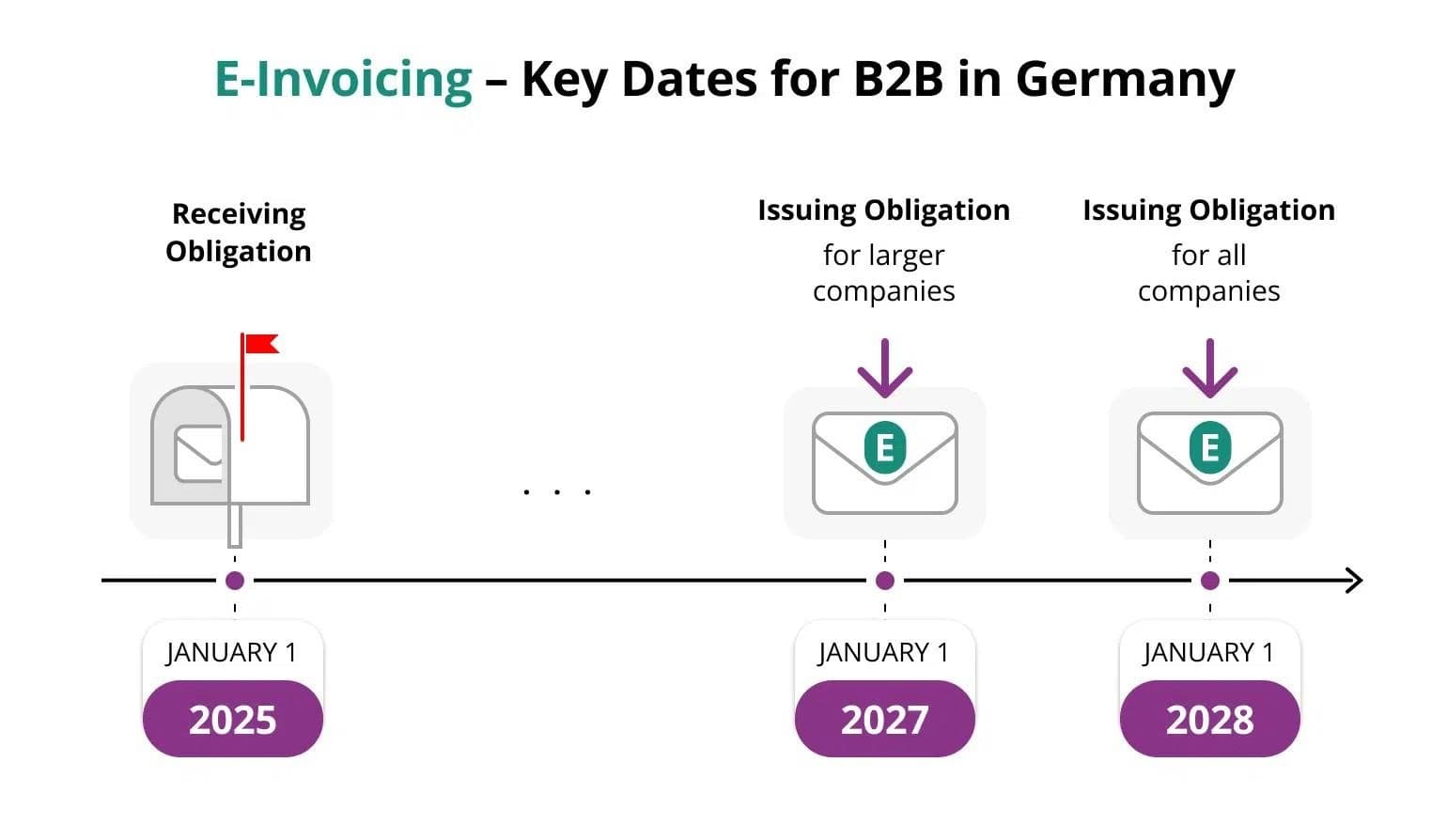
The timeline has three main dates:
- January 1, 2025: German businesses generally need to be able to receive e-invoices. This does not mean that every business already has to issue them.
- January 1, 2027: The general transition period has expired. For qualifying transactions, businesses whose prior-year turnover exceeds €800,000 generally need to issue structured e-invoices from this date.
- January 1, 2028: The turnover-based transition has expired, so qualifying domestic business-to-business (B2B) transactions generally require e-invoices regardless of the issuer’s turnover, subject to the applicable exceptions.

Germany’s B2B e-invoicing timeline and key deadlines. Image source: Finblick
Saying an e-invoice is mandatory for B2B in Germany needs some context. The applicable deadline depends on the transaction, the company’s turnover, the transition period, and any statutory exceptions.
- The rules generally do not apply to business-to-consumer (B2C) invoices. Exceptions also include certain tax-exempt transactions, small-value invoices up to €250 gross, qualifying tickets, and supplies made by businesses covered by Germany’s small-business value-added tax (VAT) scheme.
- Business-to-government (B2G) invoicing follows a separate regulatory framework. Invoices sent to public authorities can already be subject to electronic invoicing requirements, so these rules should not be confused with Germany’s domestic B2B reform.
Insight: Germany entered the new e-invoicing era with a significant readiness gap. In a representative 2024 Bitkom survey of 1,103 German companies with at least 20 employees, only 45% said they could receive e-invoices, even though the receiving requirement was only weeks away. This figure shows that finance departments are still in the process of transitioning to e-invoicing.
How ViDA Changes Cross-Border E-Invoicing in the EU
Germany’s domestic e-invoice rules also fit into a wider EU move toward structured invoicing and digital reporting. Under the ViDA (VAT in the Digital Age) timetable, cross-border B2B digital reporting requirements based on e-invoicing will apply from July 1, 2030.
The EU considers the benefits of implementing e-invoicing more broadly than a mechanism for ensuring compliance. Under the ViDA initiative, the European Commission estimates that digital reporting based on e-invoicing could reduce VAT fraud by up to €11 billion per year and lower administrative and compliance costs for EU businesses by more than €4.1 billion per year over the next decade.
For companies using Salesforce, the first step is therefore to identify which deadline applies before deciding when the current invoicing process needs to change.
What Is an E-Invoice and Why a Standard PDF Is Different
An e-invoice differs from a standard PDF in how its data is structured and processed. Under the German rules, an e-invoice must contain structured electronic data that software can process automatically. Since January 1, 2025, a conventional PDF alone no longer meets this definition.
Insight: The transition to e-invoicing is visible in real invoice volumes. DATEV reported that more than 51 million e-invoices passed through its systems in the first half of 2026 alone, compared with just over 64 million during the whole of 2025. DATEV expects the 2026 total to substantially exceed the previous year’s figure, although it notes that e-invoices still represent only a relatively small part of Germany’s overall invoice volume.
The structured information is commonly stored as XML. In simple terms, XML organizes invoice data such as supplier details, amounts, tax information, and dates into defined fields that accounting systems can read without someone manually copying the information. All required VAT invoice information must be included in this machine-readable data.
Two commonly used formats that can meet these requirements are ZUGFeRD and XRechnung. Here is how they differ from the standard PDF file.
| How Standard PDFs, ZUGFeRD, and XRechnung Differ | ||||
| Format | Human-readable? | Structured machine-readable invoice data? | Can Meet German E-Invoice Requirements? | What It Means for Salesforce Users |
| Standard PDF | Yes | No | No | A PDF-only document generator will not be sufficient once mandatory e-invoicing applies to the transaction |
| ZUGFeRD | Yes. Includes a PDF representation | Yes. XML is embedded in the file | Yes | Keeps a familiar PDF for people while adding structured data that software can process |
| XRechnung | Not as a conventional PDF. A compatible viewer can display the XML in a readable form | Yes. It contains structured XML | Yes | Produces a machine-readable invoice without the additional PDF representation used by ZUGFeRD |
The German Federal Ministry of Finance identifies qualifying versions of both formats as meeting the requirements for an e-invoice.
Structured invoices can also be validated before they are sent. Validation can detect missing mandatory information or logical errors in the data. It is not itself a requirement for tax recognition, but the Ministry recommends it as a useful check.
For companies generating invoices from Salesforce data, the next question is whether the current document generator creates structured invoice data or only a PDF.
Salesforce Invoicing: Check Whether Your Current PDF Process Is Ready
Preparing your Salesforce invoice process for the new requirements starts with checking both the invoice data stored in Salesforce and the format produced by the current document generator. A company may already have complete customer and transaction data while its existing process still creates only a conventional PDF.
1. Check the invoice data in Salesforce. Review the information used to create each invoice, including:
- customer and billing details;
- seller and legal entity information;
- products or services and quantities;
- prices and VAT treatment;
- invoice and service dates;
- payment information.
For an e-invoice to meet the German requirements, the required VAT information must appear in the machine-readable invoice data so software can process it electronically.
2. Check what the document generator actually creates. Does it generate structured machine-readable invoice data, or does it simply merge Salesforce fields into a PDF template? When researching invoicing Salesforce solutions, companies may find both document-generation tools and invoicing applications. The useful comparison point is the actual output format.
3. Check whether the required data is complete. A structured invoice may expose missing information that was less obvious in a visual PDF. Review fields such as company details, tax information, service dates, invoice dates, and other data required for the chosen format before generating the document.
4. Validate the output before sending it. Technical validation can identify missing mandatory information or logical inconsistencies in the structured invoice before it is sent.
If the current Salesforce setup produces conventional PDFs only, the company will need an e-invoice-capable process before its applicable transition period ends.
Replacing a PDF-Only Salesforce Invoice Process
When the current Salesforce process produces only conventional PDFs, one option is to replace the document-generation step with an invoicing application that supports structured formats.
Salesforce users can look for ready-made solutions on AppExchange (now AgentExchange), Salesforce’s own marketplace for business apps.
Finblick by Cloudwharf is one of the applications listed there for accounting, invoicing, and e-invoice management. For businesses evaluating native Salesforce accounting software, its relevant e-invoicing capabilities are ZUGFeRD and XRechnung support and the use of existing Salesforce data during invoice generation.
Finblick – Salesforce Accounting, Quote and E-Invoice Management on AppExchange
With Finblick, creating a structured invoice follows a short sequence:
- Create or prepare the invoice in Finblick using Salesforce data. .
- Select the required e-invoice format.
- Complete any additional information required by that format.
- Generate the structured invoice.
- Store and send the resulting document through the Salesforce-based process.
When the invoice format is changed to ZUGFeRD, Finblick requires additional invoice data before document generation. Its ZUGFeRD process uses information such as the Account, invoice date, service period, due date, and language.
For teams searching for tools to create e-invoice in Salesforce, Finblick is one AgentExchange option to evaluate when a PDF-only process needs structured output.
Invoice format selection in Finblick, showing XInvoice (XRechnung) and ZUGFeRD e-invoice options
Salesforce ZUGFeRD: PDF with Embedded Structured XML
Finblick generates ZUGFeRD invoices with structured XML embedded in the PDF. This keeps the familiar PDF representation for people while adding machine-readable invoice data for software processing. The generated document can be stored in Salesforce and sent to the customer.
ZUGFeRD invoice generated by Finblick with embedded factur-x.xml file used for machine-readable invoice data
A ZUGFeRD Salesforce setup can keep existing invoice data in Salesforce while Finblick generates the structured output.
XRechnung: Structured XML without a PDF Representation
The app from Cloudwharf also supports XRechnung as an invoice output format. XRechnung contains structured XML and does not include the same additional PDF representation as ZUGFeRD. Software or a suitable viewer can present the structured information in a readable form.
Prepare for Receiving, Corrections, and Retention
E-invoicing also requires a process for receiving invoices, handling corrections, and retaining the records.
- Businesses established in Germany have had to be able to receive e-invoices since January 1, 2025, and an email inbox is sufficient for the basic receiving requirement.
- Germany’s e-invoice rules and regulations also apply to corrections. Once a transaction requires an e-invoice, a correction generally has to be issued as an e-invoice as well. During the transitional periods, other correction formats may still be allowed. Finblick supports Credit Notes and cancellation invoices, which can be used for partial corrections or complete cancellations within the invoice process.
- Retention is another requirement to plan for. For VAT purposes, businesses generally must keep copies of incoming and outgoing invoices for eight years. For an e-invoice, they must keep at least the original machine-readable invoice data unchanged.
E-Invoicing in Salesforce: What to Check Before the Deadline
In 2026, the practical task is to identify which deadline applies to your business and check what your current invoice process in Salesforce actually produces. If it already generates a qualifying e-invoice, focus on complete invoice data, validation, and a reliable process for sending and retaining the files. If it still produces conventional PDFs only, plan the replacement before the relevant transition period expires.
For companies that want to keep invoice creation connected to Salesforce, Finblick is one option to consider. It supports both ZUGFeRD and XRechnung while continuing to use Salesforce data during invoice generation.