Best PCI DSS Audit Management Software for E-Commerce (Continuous Monitoring & Script Security)

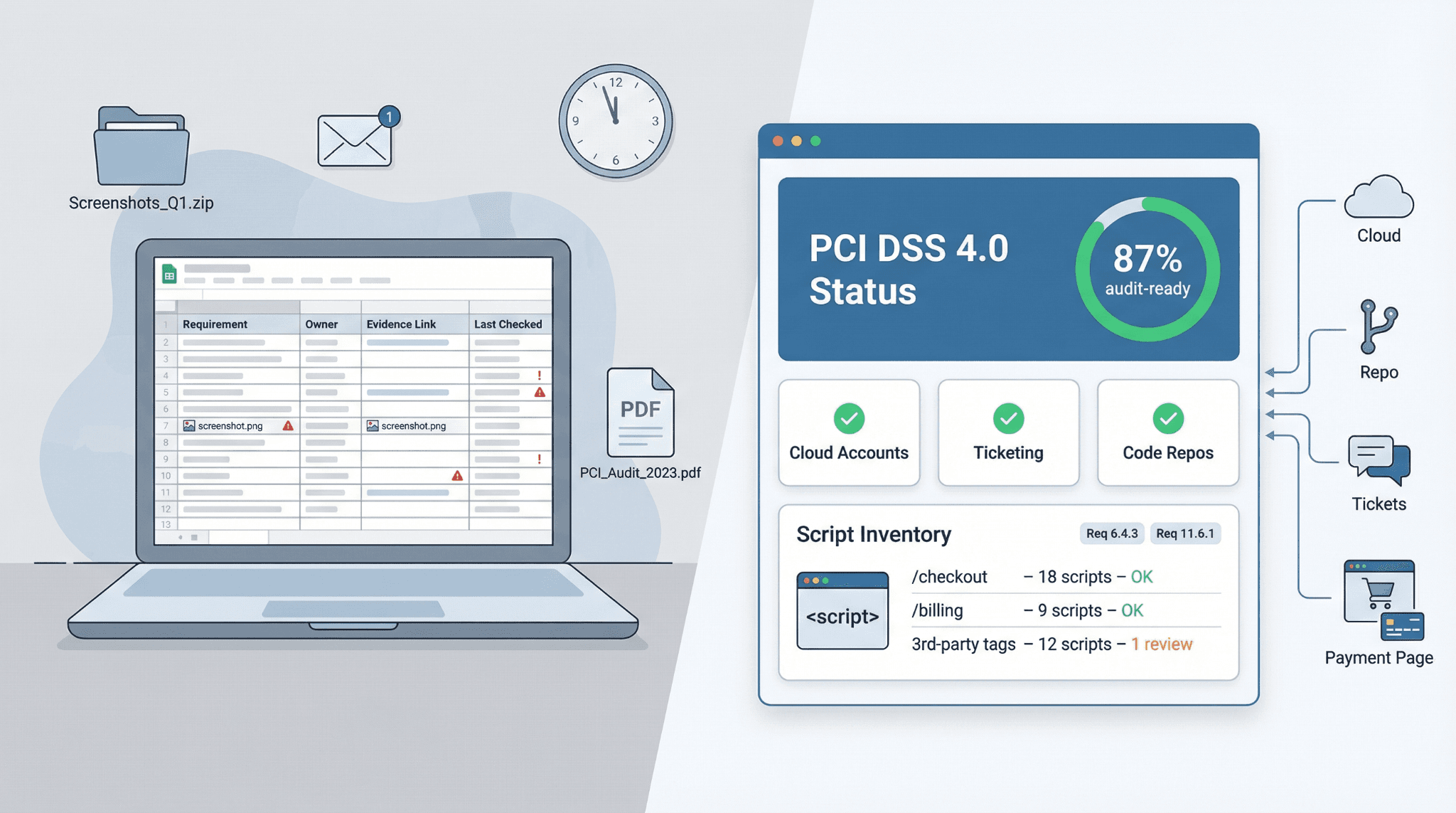
No two e-commerce stacks are identical, and no single product on this list covers the full PCI DSS 4.0 workload on its own. The following guide ranks and reviews the top solutions across compliance automation, ASV scanning, and client-side script security so you can assemble the right mix for your checkout environment.
1. Vanta: best for all-in-one compliance automation
Vanta is a compliance automation platform built to run PCI DSS as an always-on program, not a once-a-year scramble. It covers the bulk of PCI DSS 4.0 work across the 12 requirement families by continuously collecting evidence, testing controls, and keeping ownership clear across engineering, IT, and security.

Where it earns the top spot for e-commerce teams is automation depth. Vanta connects to your existing stack through 400+ integrations and runs 1,400+ automated tests on an hourly cadence—a combination that is highlighted in their comparison of best GRC software of 2026.
Vanta is also strong on the “paperwork that still matters.” In addition to evidence collection, it supports PCI scoping, gap assessments, policy management, access reviews, vulnerability management, and vendor risk management for service provider oversight (Requirement 12.8). When you are ready to package everything for an assessor, Vanta centralizes mapped evidence and helps guide SAQ, AOC, and ROC preparation, so audit prep becomes a workflow, not an ad hoc project.
What Vanta does not do: it does not provide native client-side script inventory, authorization workflows, or browser-level JavaScript monitoring. That means Requirements 6.4.3 and 11.6.1 still require a dedicated script-security tool. Vanta can track the requirements and the status of your controls, but it cannot perform payment-page integrity monitoring itself.
Deployment is straightforward. Vanta is a cloud SaaS and typically connects through read-only API integrations to tools like AWS, Azure, GCP, GitHub, GitLab, Okta, and common ticketing and HR systems. Most teams see value in hours to days once core integrations are connected, and Vanta provides a Customer Success Manager plus compliance support to help with PCI scoping. A PCI proof of concept can be completed in weeks, as seen in ChargeBee’s PCI POC.
Pricing: Vanta’s pricing is modular, based on company size and the frameworks you select. PCI DSS can be used standalone or bundled. Vendr reports a median Vanta price around $19.5K/year, but final pricing depends on scope and modules.
Best for
- Mid-market and enterprise e-commerce merchants that want a single compliance backbone for most PCI controls, plus the option to extend into SOC 2, ISO 27001, HIPAA, and more without rebuilding the program later
- Teams that value deep integrations and continuous monitoring, and want audit evidence to be exportable and mapped to specific PCI clauses
Key differentiator
Vanta’s combination of integration breadth (400+), automated test depth (1,400+), and hourly monitoring cadence. It also reduces duplicate work through cross-framework mapping, with PCI work contributing to NIST CSF 2.0, CMMC 2.0, and CRI Profile coverage.
What to pair it with
- A client-side script security tool (Source Defense, Reflectiz, Feroot, and similar) for Requirements 6.4.3 and 11.6.1
- An ASV scanner (such as Qualys) for Requirement 11.3.2, quarterly external scans
If your goal is to get PCI into a steady, auditable operating rhythm, Vanta is the strongest starting point on this list. Just plan for a script-monitoring layer, because PCI 4.0 moved the goalposts into the browser.
2. Qualys PCI Compliance: the ASV scanner that banks recognize
Qualys is a PCI SSC-authorized Approved Scanning Vendor (ASV), which is why it shows up so often in bank requirements and PCI checklists. In practical terms, it covers the non-negotiable piece of many merchant programs: Requirement 11.3.2 quarterly external vulnerability scans.

If your goal is to pass external scanning with minimal friction, Qualys is built for speed. It is cloud SaaS, so there is no complex install for basic ASV scanning. You enter the in-scope public IP ranges, schedule the scan, and get results back quickly, often within minutes to hours for initial setup and execution.
Where Qualys earns its reputation is in the output. It generates two distinct PCI reports:
- PCI Executive Report: designed for submission to acquiring banks, with an option to auto-submit your compliance status directly
- PCI Technical Report: designed for remediation teams, with the details needed to fix findings and rescan
Qualys also positions PCI as part of a broader risk and vulnerability management program. Beyond the core ASV function, the broader Qualys PCI compliance solution is described as covering 97%+ of PCI DSS requirements through modules such as asset management, vulnerability detection, web application scanning, configuration management, and SAQ completion. It also sits within the Qualys Enterprise TruRisk Platform and supports integrations into ticketing and security operations workflows through APIs.
What Qualys does not do: it does not address the new browser-side controls in PCI DSS 4.0. Qualys does not provide client-side script inventory or authorization for Requirement 6.4.3, and it does not perform payment-page integrity monitoring for Requirement 11.6.1.
Continuous monitoring approach: Qualys supports scheduled quarterly scans (required) plus on-demand scanning. It also claims Six Sigma scanning accuracy at 99.9996%, which is aimed at reducing noise and rework in scan cycles.
Pricing: Qualys offers a free trial, and smaller merchants often receive bank-sponsored access at little or no cost. For web application coverage, Qualys Web Application Scanning starts at $1,995/year for 25 web apps. Overall pricing scales with IPs, web apps, and user licenses.
Best for
- Any merchant that needs a widely accepted ASV for quarterly external scans
- Security teams that want PCI scanning to feed into existing vulnerability management and ticketing workflows
Limitations to plan for
- Not a compliance automation platform, so it will not run your policies, access reviews, or audit task management
- No client-side script monitoring, so it cannot satisfy PCI 4.0 Requirements 6.4.3 and 11.6.1 by itself
What to pair it with
- A compliance automation platform (Vanta) for the broader PCI program and audit prep
- A script-security tool (Source Defense, Reflectiz, or Feroot) for PCI 4.0 payment-page script inventory and tamper detection
For most e-commerce teams, Qualys is best treated as the scanning engine you plug into a bigger PCI stack, not the stack itself. OfficeMax captures the appeal plainly: “Qualys has been easy for us to deploy, and makes it possible for us to secure our systems, save time, and maintain PCI compliance more easily.”
3. Source Defense: real-time script bodyguard for your checkout
Source Defense is a client-side script security tool built for the part of PCI DSS 4.0 that traditional compliance platforms do not cover. It focuses on payment-page scripts, third-party tags, and the browser itself, which is where modern Magecart-style skimming actually happens.

In PCI terms, Source Defense is aimed squarely at the new requirements:
- Requirement 6.4.3: maintain an inventory of scripts on payment pages, document and justify them, and ensure changes are authorized
- Requirement 11.6.1: detect (and respond to) tampering and suspicious behavior on those pages
The product’s core design choice is prevention, not just visibility. You deploy it either as a single JavaScript snippet on your payment pages or via a reverse proxy. From there, Source Defense sandboxes third-party tags so they can still run for business functions, but it can also block suspicious behavior and stop data exfiltration attempts in the browser.
That prevention-first posture shows up in the audit trail too. Source Defense builds the script inventory PCI asks for and pairs it with the operational details auditors care about, including business justifications, approvals, and change history. If marketing adds a new tag or an existing script changes unexpectedly, you get an alert, and you can approve, investigate, or block.
Time to value and trial: Source Defense offers a free 30-day PCI 4.0 compliance edition designed to get you to “proof” quickly for a single site. The trial includes full script inventory, justification documentation, integrity monitoring on a weekly cadence during the trial (then monthly afterward), plus alerting and blocking.
Integrations: Source Defense can plug into existing security and compliance workflows, including piping alerts into broader compliance suites and SIEM-driven processes, so client-side events do not live in a separate island.
Pricing: Paid pricing is not publicly disclosed and is often positioned at the enterprise level. Industry estimates place deployments in the $10K to $50K+ range, depending on traffic and page coverage.
Best for
- E-commerce teams that want real-time prevention against skimming and formjacking, not only after-the-fact detection
- Merchants with frequent third-party tag churn who need a clean approval workflow and an always-current script inventory
Limitations to plan for
- This is not a full PCI compliance platform. It does not replace your policy management, access reviews, or broader evidence collection
- It is not an ASV scanner for quarterly external scans
- Deployment requires adding a snippet to payment pages or using a proxy model
What to pair it with
- A compliance automation platform (Vanta) for the rest of the PCI program
- An ASV scanner (Qualys) for Requirement 11.3.2 external scans
If PCI 4.0 pushed you into weekly script reviews and you do not want that to become a permanent calendar event, Source Defense is one of the clearest “close the browser gap” options, especially if blocking matters as much as detection.
4. Reflectiz: agentless visibility for third-party script sprawl
Reflectiz is a client-side monitoring tool designed for PCI DSS 4.0 teams that need fast visibility into what runs on their site, especially when engineering access is limited. Its defining trait is that it is fully agentless. There are no code changes, no JavaScript tags, and no performance impact because Reflectiz monitors your site externally by crawling it with virtual users.
That approach maps well to the two browser-side PCI requirements most merchants are now wrestling with:
- Requirement 6.4.3: build and maintain an inventory of scripts and support an authorization and justification workflow
- Requirement 11.6.1: detect changes and suspicious behavior on payment pages on an ongoing basis
Reflectiz discovers first- and third-party scripts, cookies, and network calls, then assigns risk scoring and alerts you when something new appears or an existing asset changes. It also includes approval workflows, and “smart approvals” use AI-driven logic to reduce false positives and keep the review queue manageable.
Where Reflectiz tends to shine in audits is in documentation. It includes a proprietary PCI dashboard with one-click, audit-ready compliance documentation, plus exportable inventories, change logs, and approval records for QSA review. Reflectiz also reports an average 83% reduction in manual compliance tasks, which is meaningful if your current process is weekly diffs and screenshot capture.
Deployment and time to value: Because it is external and agentless, Reflectiz is one of the fastest tools to roll out on this list. Point it at your URLs, and you can start seeing findings in about five minutes. This is particularly useful on platforms where inserting another script is hard or politically fraught, for example, Shopify themes or legacy checkout systems.
Integrations: Reflectiz integrates with tools like Splunk and Jira, and it can connect to SIEM and SOAR workflows through a bi-directional, JSON-based REST API.
The key trade-off: Reflectiz is detection-only. It can surface changes quickly, but it cannot block a rogue script in real time. Because it monitors from the outside, there is also inherent latency compared to in-browser, real-time enforcement tools. If your risk tolerance requires prevention, you will need either a tight incident response loop or a blocking solution alongside it.
Pricing: Reflectiz offers Standard, Professional, and Enterprise tiers, with pricing based on the number of web assets. A free trial is available. Industry estimates often range from $10K to $50K/year for small to mid-sized deployments, and $50K to $100K+/year for large enterprises managing many sites.
Best for
- Merchants that cannot easily modify checkout code but still need PCI 4.0 script inventory and monitoring evidence
- Teams with heavy third-party tag sprawl that want fast, code-free visibility and clean audit exports
Limitations to plan for
- No real-time blocking; therefore, it does not stop exfiltration on its own
- External crawling introduces latency compared to tools that monitor directly in the browser
- Higher pricing is common for enterprise feature sets and multi-site rollups
What to pair it with
- A prevention-first client-side tool (such as Source Defense) if blocking is required
- A compliance automation platform (Vanta) for the broader PCI program
- An ASV scanner (Qualys) for quarterly external scans
If you need a “no engineering required” path to PCI 4.0 script visibility and audit documentation, Reflectiz is one of the fastest ways to get there. Just be clear-eyed about the difference between knowing something changed and stopping it mid-transaction.
5. Feroot Inspector & PaymentGuard: PCI evidence on autopilot
Feroot is a client-side security vendor built around the two PCI DSS 4.0.1 requirements most e-commerce teams struggle to operationalize: 6.4.3 (script inventory, justification, authorization, and integrity) and 11.6.1 (ongoing tamper detection on payment pages). It does not try to be a full compliance platform. It focuses on making payment-page script compliance measurable, repeatable, and easy to prove.
Feroot splits the work into two products that map cleanly to how auditors think:
- Inspector performs periodic scans across your site routes to surface risky JavaScript frameworks, outdated libraries, and weak configurations like loose Content Security Policies (CSPs).
- PaymentGuard monitors live checkout behavior, tracking page and DOM changes in real time and alerting when scripts change, headers change, new domains appear, or code begins interacting with sensitive payment fields.
That combination is the point. Inspector gives you breadth across the site, while PaymentGuard gives you depth where it matters most, at the moment of transaction. Feroot also positions this as both detection and prevention, using behavioral analysis to identify skimming and formjacking patterns and stop unauthorized access to cardholder data.
Deployment and time to value: Feroot is designed to be light-touch. You typically deploy with a single tag for monitoring and an API key for scans. Tag manager integrations can pull in existing allowlists, so you are not rebuilding approved-script inventories from scratch. During initial rollout, AI-driven baselining helps reduce false positives in the first learning week.
Audit evidence generation: Feroot leans into the QSA workflow. It can export QSA-ready evidence packs that include a script inventory, approvals, change logs, screenshots, and enforcement activity records, bundled in the folder structure many assessors already expect. If your current process involves assembling artifacts by hand, this is one of the biggest time savers.
Integrations: Feroot supports a broad set of operational integrations, including Slack, PagerDuty, Splunk, ServiceNow, Jira, Datadog, Microsoft Teams, Sumo Logic, Opsgenie, CloudWatch, Logz.io, JupiterOne, webhooks, and a custom API. That makes it easier to route client-side incidents into the same on-call and incident response flows you use for infrastructure.
A differentiator worth calling out: Feroot covers websites and mobile apps, including iOS and Android payment flows. If your checkout experience lives partly in a native app, this multi-channel coverage is a practical advantage over tools that only watch browser pages.
Pricing: Feroot publishes a lower entry point than many enterprise-focused script security tools, with starter packages from $5K/year ($415/month). Pricing scales with pages, traffic, and per-site deployment.
Best for
- Mid-market e-commerce teams that want strong PCI 4.0.1 coverage for 6.4.3 and 11.6.1, plus clean, exportable audit proof
- Merchants with multiple storefronts, frequent tag changes, or mobile payment flows
- Teams that want one vendor for both periodic scanning and live checkout monitoring
Limitations to plan for
- Client-side focus only; it does not replace a compliance automation platform for the rest of PCI DSS
- Not an ASV scanner, so you still need quarterly external scanning coverage elsewhere
What to pair it with
- A compliance automation platform (Vanta) for policies, access reviews, and broader evidence collection
- An ASV scanner (Qualys) for Requirement 11.3.2, quarterly external scans
Feroot is a strong fit when your priority is not only “detect skimmers,” but also “hand the auditor a complete evidence pack without a week of formatting.”
6. Copla: PCI DSS compliance software for streamlined compliance management
Copla is a PCI DSS compliance software platform designed to help businesses manage their compliance program, organize evidence, and stay audit-ready without relying on disconnected spreadsheets and manual processes. For e-commerce teams, it provides a centralized way to manage PCI DSS requirements and keep compliance work moving throughout the year rather than treating it as a once-a-year audit project.
Where Copla fits particularly well is in the compliance management layer. PCI DSS requires more than technical security controls: organizations also need policies, procedures, documented responsibilities, evidence, reviews, and proof that controls are operating as intended. Copla helps bring those activities into one structured workflow, giving teams a clearer view of what needs to be completed, who owns each task, and what evidence supports each requirement.
That makes it a useful option for businesses looking for PCI DSS compliance software without necessarily needing a large enterprise GRC platform. Instead of tracking requirements across spreadsheets, shared drives, email threads, and separate task-management tools, teams can use Copla to centralize compliance activities and maintain a more consistent audit trail.
The platform is especially relevant for organizations that need to demonstrate ongoing compliance readiness. Rather than scrambling to collect documentation before an assessment, teams can maintain evidence and compliance records continuously. This approach can help identify gaps earlier and reduce the administrative workload associated with preparing for a QSA review or other compliance assessment.
What Copla does not do: it is not an ASV scanner and does not replace quarterly external vulnerability scanning required under PCI DSS Requirement 11.3.2. It also does not provide the same specialized client-side script monitoring and real-time prevention capabilities as tools such as Source Defense, Reflectiz, or Feroot. Businesses with payment pages in scope for PCI DSS 4.0.1 Requirements 6.4.3 and 11.6.1 may therefore need to pair Copla with dedicated technical security tools.
Deployment and time to value: Copla is designed to simplify the operational side of compliance rather than require a large infrastructure deployment. Teams can use it to structure their PCI DSS program, organize compliance documentation, and establish repeatable processes for evidence collection and ongoing compliance activities. This makes it a practical fit for organizations that want to improve their compliance workflow without building a complex internal system from scratch.
Audit readiness: The main value of Copla is keeping compliance work organized and accessible. Instead of reconstructing evidence and documentation at the end of the audit cycle, teams can maintain a continuous record of compliance activities and supporting materials. This helps make the audit process more predictable and gives internal stakeholders a clearer picture of compliance status.
Integrations and workflow: Copla works best as the central compliance management layer in a broader security stack. Technical controls, vulnerability scans, and security monitoring can feed into the overall compliance process, while teams use the platform to track requirements, ownership, documentation, and remediation activities. This separation between compliance management and technical enforcement allows businesses to build a stack around their specific checkout environment.
Pricing: Pricing depends on the organization’s requirements, scope, and selected features. Businesses evaluating Copla should compare the total cost against the time spent managing PCI DSS compliance manually, including evidence collection, documentation, remediation tracking, and audit preparation.
Best for:
E-commerce businesses looking for PCI DSS compliance software to centralize compliance management, documentation, evidence, and audit preparation
Small and mid-market teams that want a structured alternative to spreadsheets and disconnected compliance workflows
Organizations that need to maintain ongoing PCI DSS readiness and clearly track ownership of compliance activities
Limitations to plan for:
Not an ASV scanner, so quarterly external vulnerability scanning still requires an approved scanning vendor
Does not replace dedicated client-side script monitoring or prevention tools for PCI DSS 4.0.1 Requirements 6.4.3 and 11.6.1
Technical security controls may still require separate tools alongside the compliance management platform
What to pair it with
An ASV scanner such as Qualys for Requirement 11.3.2 quarterly external scans
A client-side security platform such as Source Defense, Reflectiz, or Feroot for payment-page script inventory, authorization, and tamper detection
A broader vulnerability and security monitoring stack for technical controls that require continuous monitoring
For organizations that want to move away from manual PCI DSS administration, Copla provides a centralized compliance management layer that can make ongoing readiness easier to maintain. It is best viewed as the operational backbone of a broader PCI stack, helping teams manage the people, processes, documentation, and evidence behind compliance while specialized tools handle scanning and technical security controls.
Buyer’s guide: match the tool stack to your checkout reality
No single product on this list covers the full PCI DSS 4.0 workload on its own. The easiest way to choose is to think in layers:
- Compliance backbone (Vanta) for policies, evidence, and the bulk of PCI controls
- ASV scanning (Qualys) for mandatory quarterly external scans (Requirement 11.3.2)
- Client-side script security (Source Defense, Reflectiz, Feroot) to meet the new browser-side requirements, especially 6.4.3 and 11.6.1
1) Start with your payment flow and scope
Ask one question first: Does your payment page live on your domain?
- If you redirect to a hosted payment page, iframe, or drop-in component where the payment experience stays on the PSP’s domain, you may qualify for SAQ A and avoid much of the script-monitoring burden. In that case, a compliance suite can handle the program mechanics, and an ASV scanner can cover quarterly scans.
- If you serve any part of the payment page yourself, script security is no longer optional. PCI 4.0 expects you to inventory scripts, authorize changes, and detect tampering on an ongoing basis.
2) Decide whether you need prevention or detection
If you are in scope for 6.4.3 and 11.6.1, choose your posture:
- Prevention-first: Source Defense can stop suspicious behavior in real time. This is the safer choice when each minute of skimming creates immediate financial exposure.
- Detection-first: Reflectiz and Feroot can surface changes quickly and generate strong audit artifacts. This works when you can remediate fast, and you mainly need clean evidence and visibility.
- Some teams choose a hybrid, using a visibility-first tool to get instant coverage and governance, then adding blocking later where it matters most.
3) Check your deployment constraints
Your platform often dictates the right tool more than feature checklists do.
- If you cannot easily change checkout code, an agentless approach like Reflectiz can be the fastest path to a usable inventory and monitoring record.
- If you need real-time blocking and prevention without redesigning your checkout, a snippet- or proxy-based tool, such as Source Defense, fits.
- If you have multiple storefronts or mobile checkout flows, Feroot’s combination of periodic scanning and live monitoring covers both web and mobile under one vendor.
4) Budget for total cost, not sticker price
Spreadsheet weekends, audit fire drills, and incident response time cost real money.
Script-security tooling is often budgeted annually, and ranges can be wide. Reflectiz’s cost analysis cites typical spend bands of $10K to $50K/year for small businesses (1 to 5 pages), $15K to $70K/year for mid-sized (5 to 10 pages), and $50K to $100K+/year for enterprise (10+ pages). There are meaningful exceptions. Feroot starts at $5K/year ($415/month), and Source Defense offers a free 30-day PCI 4.0 trial.
Whatever you pick, compare that to downside risk. A single missed control can trigger fines, forced forensic audits, or loss of trust, and fines can reach $90 per stolen card.
5) Match the workflow to your team
The “best” tool is the one your team will actually keep running.
- Teams that want one compliance backbone for the bulk of PCI controls tend to lead with Vanta and pair it with a dedicated script-security layer.
- Detection-first teams that cannot easily modify checkout code tend to prefer Reflectiz, often paired with Feroot for clean audit packs and mobile coverage.
- Prevention-first teams that need real-time blocking on payment pages without breaking analytics or chat tend to lead with Source Defense.
Conclusion
If you build the right stack, PCI stops being an annual scramble and becomes a background process that supports shipping, growth, and safer checkout experiences.