Amazon FBA vs 3PL vs Hybrid: Fulfillment Strategies ExplainedTitle

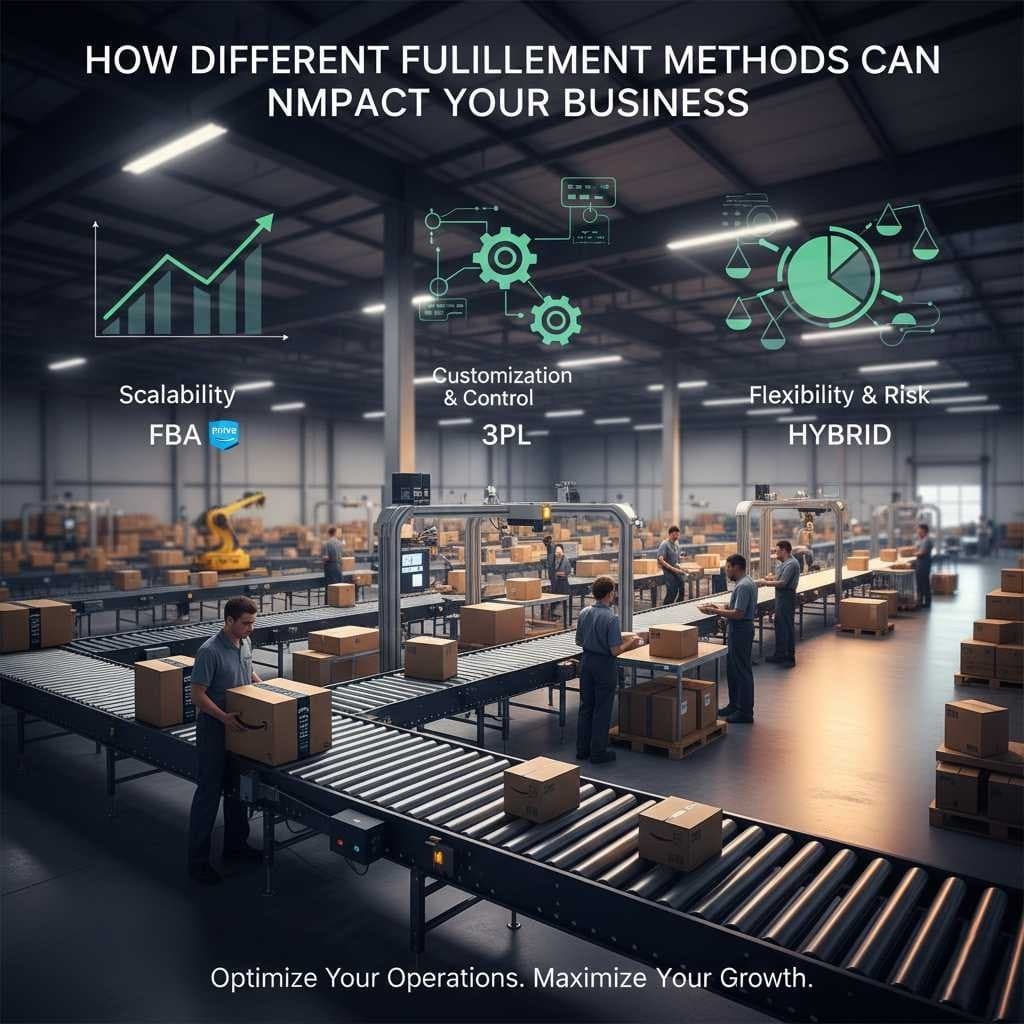
How Different Fulfillment Methods Can Impact Your Business
The success of ecommerce, now, is less about product quality or marketing pizazz. The behind-the-scenes journey of the order fulfillment from click to doorstep is equally, if not more significant, to customer loyalty and profit margins.
- Making the wrong choice, and you experience cash bleed through costly storage surcharges or jeopardize your Prime status.
- Making the right choice, and your fulfillment partner becomes a stealth brand ambassador that delights shoppers again and again.
In this deep dive, we outline FBA vs. 3PL vs. Hybrid options, how each option shifts the levers of cost and control, and how to create a roadmap that meets the ever-evolving demands of the market.
The Fulfillment Landscape at a Glance
Before we compare specifics, it helps to define the three dominant models shaping today’s online retail scene.
- Fulfillment by Amazon FBA stores, picks, packs, and ships your products from Amazon’s nationwide warehouse grid, automatically granting Prime status on marketplace listings.
- Third-party logistics 3PL partners run independent warehouses and shipping workflows, giving brands broader packaging freedom, multichannel reach, and often lower long-term storage rates.
- A Hybrid strategy mixes both, sending high-velocity SKUs to FBA for fast Prime delivery while routing slower movers or wholesale B2B orders through a 3PL.
Discover Which Fulfillment Method Works Best for You: FBA vs 3PL vs Hybrid
Why Fulfillment Choices Are Now Boardroom Decisions
The days of treating fulfillment as a back-office afterthought are gone. Consider these marketplace forces pressing CEOs and operations leads to revisit their models quarterly instead of yearly.
- Amazon FBA fees rise on a predictable but relentless cadence, and preliminary announcements for Amazon FBA fees 2025 confirm more penalties on low-inventory depth.
- Two-day shipping has become table stakes, while next-day and same-day windows grow more common in metro areas.
- Packaging that reflects brand values boosts repeat purchase rates, yet FBA’s standardized brown box limits creative control.
- Sustainability pressure is pushing merchants to rethink route miles, corrugate use, and return handling policies, all issues determined largely by your fulfillment setup.
Fail to adapt, and your hard-won margin evaporates in a fog of FBA fees and customer churn.
Key Strengths of the Model
FBA
- Instant Prime trust and search rank boost
- Minimal startup complexity
- Hands-off returns processing
3PL
- Full branding freedom and gift experience
- Centralized inventory for multichannel picking
- Negotiable rates, especially on bulky items
Hybrid
- Prime badge for top sellers, lower costs for everything else
- Risk mitigation when one network faces carrier delays
- Strategic buffer that smooths peak-season volatility
Cost Mechanics: More Than Just a Storage Bill
A lot of founders glance at an FBA revenue report and decide Amazon seems “cheaper” because charges come pre-deducted. A closer look tells a different tale. When weighing Amazon FBA vs 3PL, break the total landed cost into its components.
- Inbound receiving fees
- Pick and pack or unit handling fees
- Weight-based outbound shipping fees
- Monthly and long-term storage fees
- Return processing fees
- Special prep or relabeling surcharges
FBA wraps many of these into published rate cards, yet the net amount can swing wildly during Q4 peak. Third-party partners invoice line by line, making comparisons appear messy at first glance but easier to negotiate over time. The hybrid approach lets you arbitrage both systems; fast movers stay under the Prime umbrella while bulky or seasonal stock rides lower warehouse bills in a 3PL.
Brand Control and Customer Experience
Modern shoppers want more than speed; they crave a story. Unboxing moments shared on TikTok or Instagram drive incremental traffic you never paid for. Here is how each model shapes that narrative.
- FBA ships in Amazon-branded outer cartons, largely erasing your logo in the first physical touchpoint, yet the predictable FBA fees also buy you Prime trust and lightning-fast delivery that fuels positive reviews.
- 3PL partners allow custom boxes, eco fillers, gift notes, and inserts that reinforce your values while letting you redirect the dollars saved from FBA fees into elevated packaging or surprise gifts.
- A hybrid set-up sends influencer seeding kits or subscription bundles through the 3PL while regular Prime orders remain on FBA for convenience, meaning you keep the competitive advantage of streamlined FBA fees on high-velocity items and the creative freedom of bespoke packaging elsewhere.
If retention and cross-sell rely on packaging creativity, the math leans toward either independent 3PL or a blended flow that extracts maximum branding impact without losing the operational benefits baked into Amazon’s transparent FBA fees.
Decision Matrix Questions Every Operator Should Ask
- What percentage of total revenue comes from the Amazon marketplace relative to owned channels?
- How sensitive is your audience to Prime badges versus eco packaging and handwritten notes?
- Are your SKUs uniform in size, or do you stock oversized and low-density goods that trigger extra Amazon FBA fees?
- Do you launch seasonal product lines that sit longer than 270 days, thus incurring long-term storage charges?
- Would flexibility in wholesale carton or pallet shipping open revenue not currently captured?
Plot these answers on a two-axis chart of Cost versus Control. You will often see the sweet spot move toward a mix rather than a single solution.
Speed, Reach, and Channel Flexibility
- Amazon’s fulfillment network can hit most US ZIP codes in one or two days, satisfying Prime shoppers by default.
- Top-tier 3PL facilities strategically placed in multiple regions now mirror that delivery promise for Shopify, Walmart Marketplace, and TikTok Shop orders, proving that the old FBA vs 3PL speed gap is narrowing fast.
- A growing share of merchants fund expansion into Europe, Canada, or Australia. FBA requires separate accounts and inventory duplication, whereas global 3PL networks can push inventory across borders with a single dashboard.
When you stack those facts against your channel mix, the so-called Amazon FBA third-party fulfilment option becomes just one piece of a broader distribution puzzle.
Real-World Example
A direct-to-consumer fitness brand stocked 130 SKUs entirely with Amazon for three years. Rising long-term storage charges clipped margins by 18 percent. After shifting oversized yoga mats and low-velocity accessories to a California 3PL while keeping bestselling resistance bands in FBA, the company:
- Cut total storage spend by 28 percent within two quarters.
- Lifted website conversions by 12 percent thanks to branded unboxing.
- Reduced January stockouts by drip-feeding inventory from the 3PL to FBA weekly.
Hybrid is not just a buzzword; it is a practical lever for stability.
Common Misconceptions to Bust
- FBA is automatically the cheapest option in every category. Hidden seasonal hikes can flip the equation once FBA fees accumulate.
- 3PL partners cannot deliver two-day service. Many now preload inventory in multiple nodes and achieve the same SLA without Prime logos.
- Small brands cannot manage separate pipelines. Modern OMS software auto-routes orders, making fba vs 3pl providers’ cooperation seamless even for two-person startups.
Final Thoughts
Fulfillment is no longer a binary choice; it is a dynamic spectrum where the optimum point moves as fees, buyer expectations, and supply chains evolve.
The debate is not just FBA vs 3PL but also which blend of each creates the strongest customer experience at the healthiest margin.
Keep testing, stay data-driven, and treat your fulfillment network as a living ecosystem that deserves quarterly attention.
When you master that mindset, logistics transforms from an overhead line on your P and L into a tactical weapon that fuels sustainable growth year after year.
FAQ Section
How do FBA fees compare with 3PL invoices?
FBA bundles pick, pack and transport into standardized rates, which can simplify accounting but mask true per-unit costs during high-season surcharges. 3PL bills appear granular yet often end lower for slow movers or bulky SKUs once negotiated storage discounts apply.
Will the announced Amazon FBA fees for 2025 change the ROI math
Yes. Added low-inventory and dim-weight surcharges mean brands with inconsistent replenishment cycles will pay more. Running cost models now let you avoid nasty surprises and may push part of your catalogue to a 3PL or hybrid flow.
Is Amazon FBA third-party fulfilment still worthwhile if I sell mostly on my own Shopify store
It depends on catalogue velocity. Fast movers that benefit from Prime’s algorithm can remain in FBA while direct-site orders route through your 3PL. This FBA vs. warehouse 3PL providers split preserves speed for marketplace traffic and branding freedom for your highest-margin customers.
How long does it take to transition from pure FBA to a hybrid
Brands with clean SKU data and a cloud-based inventory platform can stage inventory to a new 3PL in as little as four weeks. Conduct a phased rollout, starting with your slowest or heaviest items, then expand once metrics confirm savings.
Author Bio
Arishekar N. is the director of marketing and business development at AMZ Prep. Bringing decades of experience in driving growth for e-commerce businesses, he has established himself as a thought leader in the digital marketing space.
His expertise spans strategic marketing, e-commerce operations, SEO, advertising, and branding. Arishekar has successfully led numerous campaigns that have yielded specific achievements, such as a 200% increase in online sales for client businesses.
As a regular contributor to respected industry publications, Arishekar shares valuable insights on optimizing online business performance and navigating the ever-changing e-commerce landscape. His data-driven approach and commitment to ethical marketing practices have earned him recognition as a trusted voice in the industry.
Arishekar dedicates his efforts to equipping entrepreneurs and marketers with practical strategies that can significantly enhance their financial performance. For the latest trends, tips, and expert analysis in e-commerce and digital marketing, follow Arishekar N on https://in.linkedin.com/in/arishekar