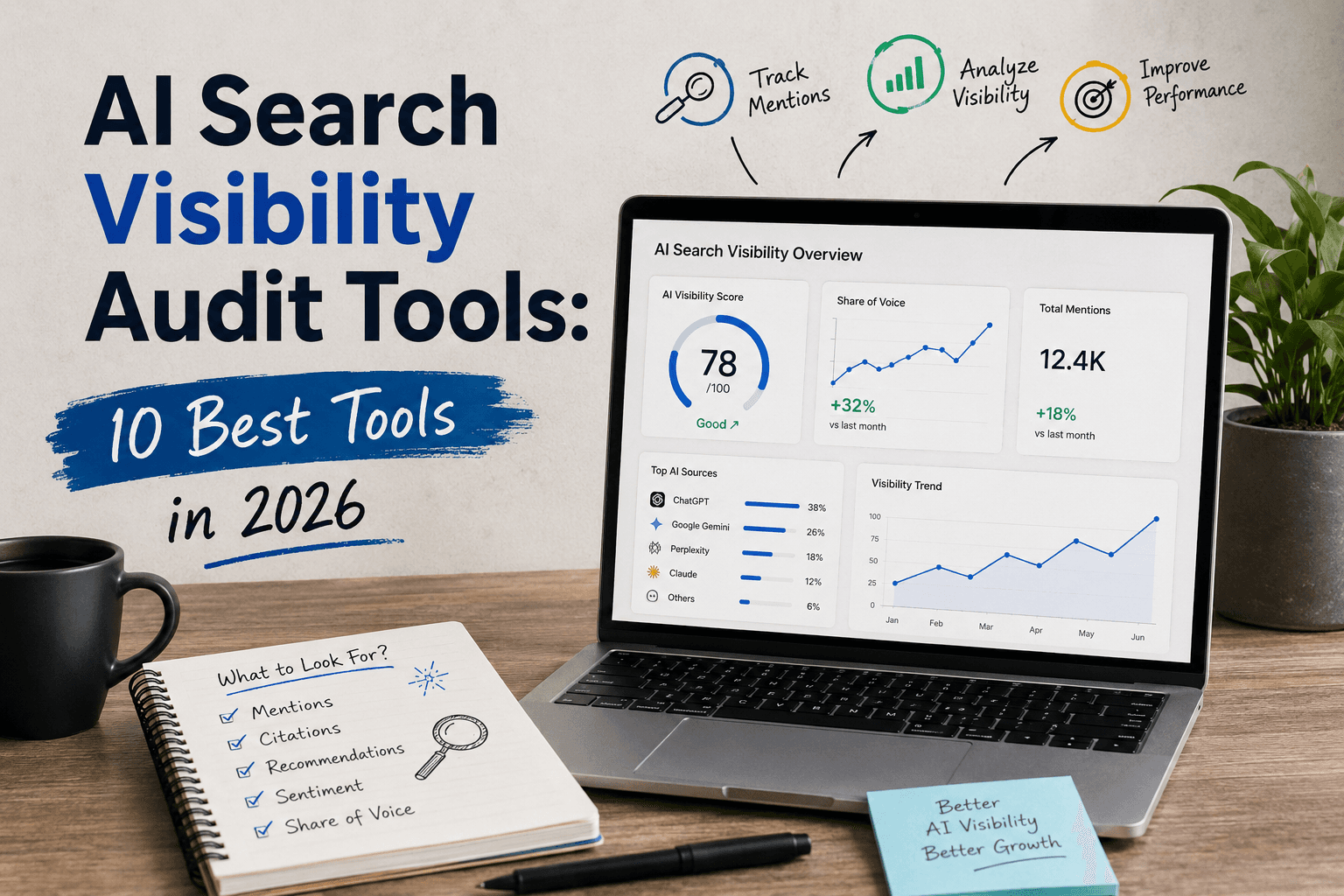
AI Search Visibility Audit Tools: 10 Best Tools in 2026

AI search is changing how people find brands, compare products, and decide what to buy. Instead of using Google alone, people are increasingly turning to ChatGPT, Gemini, Perplexity, Claude, and Google AI Overviews for direct answers and recommendations.
That raises a new question for marketers and SEO teams:
How visible is your brand in AI search?
Traditional SEO tools can show you where your website ranks on Google, how many backlinks you’ve earned, and which keywords bring in organic traffic. But they don’t necessarily tell you whether ChatGPT recommends your brand, which websites AI systems use as sources, or whether your competitors are showing up in answers where your brand is nowhere to be found.
That’s where AI search visibility audit tools come in.
These platforms help marketers track brand mentions, citations, share of voice, sentiment, competitor visibility, AI recommendations, and other signals across AI-powered search experiences.
Here are 10 tools worth considering in 2026, along with what each one does best.
What Is an AI Search Visibility Audit?
An AI search visibility audit looks at how a brand appears across AI-powered search and answer engines.
Instead of asking:
“Where does my website rank for this keyword?”
an AI visibility audit asks:
- Does AI mention my brand?
- How often is my brand mentioned?
- Is my brand actually recommended, or just referenced?
- How does my visibility compare with competitors?
- Which websites are AI systems citing?
- Is my own website being cited?
- What does AI say about my brand?
- Is that information accurate?
- Which prompts generate visibility for my brand?
- Where are competitors appearing instead of me?
The methodology isn’t the same across every platform. Some tools run predefined or custom prompts, while others work with large datasets of search queries or AI conversations.
There’s another thing to keep in mind: AI responses can change based on the prompt, model, location, and timing. So an AI visibility audit is better viewed as an ongoing measurement system than as one fixed ranking.
Recent GEO research also points to the fact that AI visibility isn’t just a single ranking problem. Discovery, retrieval, citations, prominence, factual accuracy, and user behavior can all play a role.
10 Best AI Search Visibility Audit Tools
1. Addlly AI – Best for GEO Auditing and Actionable AI Visibility Insights

Addlly AI’s GEO Audit Tool is built around a simple question: how does AI search understand and represent your brand?
The tool evaluates AI visibility across platforms such as ChatGPT, Perplexity, Claude, Gemini, Grok, and Google AI Overviews. It goes beyond counting brand mentions by looking at citations, sentiment, entity clarity, competitor visibility, and technical factors that can affect how AI systems understand a website.
One of its main strengths is the link between auditing and optimization.
The audit shows where a brand appears, how it’s being represented, which competitors are getting picked, and where visibility gaps exist. Those findings can then be used to guide content creation and optimization work.
Key capabilities
- AI brand visibility analysis
- AI mentions and citations
- Competitor benchmarking
- Sentiment and brand positioning
- Entity and brand accuracy
- GEO readiness analysis
- Technical and schema-related checks
- AI search visibility across multiple engines
- Content and optimization recommendations
Best for
SEO teams, marketers, agencies, SaaS companies, and brands that want to go from measuring AI visibility to actually improving it.
2. Profound – Best for AI Search Intelligence

Profound is one of the better-known platforms in the AI search visibility space, particularly among enterprise teams.
Its Answer Engine Insights product tracks how brands appear across AI answer engines and measures visibility, citations, sentiment, share of voice, positioning, and competitor performance.
One feature that stands out is prompt-level monitoring.
Teams can track specific prompts and see how their visibility changes over time. Profound also provides prompt-volume research based on a large dataset of AI conversations, which can help marketers understand the kinds of questions people are asking AI systems.
The platform also looks at citation sources and can categorize them into areas such as owned websites, competitors, earned media, social platforms, and institutions.
Key capabilities
- AI visibility scoring
- Share of voice
- Prompt tracking
- Citation analysis
- Sentiment analysis
- Competitor benchmarking
- Prompt research
- AI crawler analytics
- Content gap analysis
- Enterprise reporting
Best for
Large brands, SEO teams, and organizations that need detailed AI search intelligence at scale.
3. Semrush AI Visibility Toolkit – Best for Existing Semrush Users

Semrush has extended its traditional SEO platform into AI visibility tracking with its AI Visibility Toolkit.
The toolkit lets marketers benchmark AI visibility, track mentions, analyze brand perception and sentiment, find relevant prompts, monitor visibility over time, check technical AI readiness, and compare competitors.
The biggest advantage is fairly straightforward: if your team already uses Semrush, AI visibility data can live alongside your existing SEO, keyword, backlink, and competitor research.
The platform also provides an AI Visibility Score and breaks results down by LLM, along with metrics such as mentions, cited pages, and citations.
Semrush currently offers its AI Visibility product starting at $99 per month per domain when billed annually. Features include custom prompt tracking, competitor analysis, prompt research, and AI-readiness auditing.
Key capabilities
- AI Visibility Score
- Brand mentions
- Cited pages
- Citations
- Competitor analysis
- Prompt research
- Sentiment analysis
- AI-readiness site audit
- LLM distribution
- Reporting
Best for
SEO professionals and marketing teams that already rely heavily on the Semrush ecosystem.
4. Ahrefs Brand Radar – Best for Combining AI Visibility With SEO Data

Ahrefs takes a slightly different approach to AI visibility with its Brand Radar product.
Brand Radar helps marketers track how brands appear in AI search and compare AI Share of Voice against competitors. It also identifies cited pages and domains that influence AI-generated answers.
Ahrefs also offers a free AI Visibility Checker that checks how a brand appears across ChatGPT, Gemini, Perplexity, Copilot, and Google AI Overviews.
Its AI visibility metrics include mentions, citations, impressions, and AI Share of Voice. Ahrefs defines a mention as an AI-generated response where the brand appears at least once, regardless of whether the name is repeated multiple times in that response.
The real advantage here is the connection between AI visibility and Ahrefs’ broader SEO ecosystem.
Key capabilities
- AI mentions
- AI citations
- AI Share of Voice
- Impressions
- Cited domains
- Cited pages
- Competitor comparison
- SEO and AI visibility research
Best for
SEO professionals who want to look at traditional search performance and AI visibility together.
5. Peec AI – Best for AI Search Analytics

Peec AI focuses heavily on measuring how AI represents a brand.
Its core metrics include visibility, position, sentiment, and share of voice. This gives marketers a better picture of not just whether a brand appears, but where it appears and how it’s described.
Peec also supports platform-specific tracking across environments such as ChatGPT, Gemini, and Google AI Mode. Its AI Mode tracker measures brand mentions, citation sources, sentiment, and competitor performance.
Another useful part of the platform is its focus on recommendations. Rather than simply showing that a competitor is appearing more frequently, Peec tries to connect those visibility gaps with potential actions across owned and earned channels.
Key capabilities
- AI visibility
- Position tracking
- Sentiment
- Share of voice
- Competitor benchmarking
- Citation intelligence
- Prompt tracking
- AI Mode monitoring
- Recommended actions
Best for
Marketing teams looking for straightforward AI search analytics and competitor benchmarking.
6. OtterlyAI – Best for Agencies and Ongoing Monitoring

OtterlyAI is an AI search monitoring and optimization platform designed to track how brands and websites appear across major AI search experiences.
It currently supports ChatGPT, Google AI Overviews, Google AI Mode, Perplexity, Gemini, Microsoft Copilot, and Claude.
One useful feature is its automated monitoring workflow. Users create natural-language prompts that their customers might search for, and OtterlyAI runs those prompts regularly to see whether brands are mentioned, cited, and positioned against competitors.
The platform also includes Brand Reports, domain citation tracking, competitor monitoring, prompt research, and GEO auditing.
Key capabilities
- Daily AI search monitoring
- Brand mentions
- Brand coverage
- Domain citations
- Competitor tracking
- Prompt research
- GEO audits
- Brand Visibility Index
- Reporting
Best for
Agencies, consultants, and marketing teams that need regular AI visibility monitoring across several brands or clients.
7. Writesonic GEO – Best for Visibility-to-Content Workflows

Writesonic has moved beyond AI content creation into AI search visibility monitoring as well.
Its AI Visibility Tracker monitors how brands appear across several AI platforms and provides data on visibility, citations, sentiment, and share of voice. Teams can also filter results by competitors, market, language, and intent.
The platform identifies cited domains and pages too, which helps marketers understand the types of sources influencing AI-generated answers.
This is useful for teams that don’t want AI visibility tracking sitting in a separate workflow from content production. A team can identify a visibility gap, understand what sources are influencing the answer, and then use those findings to guide content work.
Key capabilities
- AI visibility tracking
- AI Visibility Scores
- Sentiment
- Share of voice
- Citation analysis
- Competitor tracking
- Market and language filters
- Content optimization
- Reporting
Best for
Content marketing teams that want to connect AI visibility research with content creation and optimization.
8. Scrunch – Best for Technical AI Search and AI Agent Visibility

Scrunch takes a somewhat different approach.
Instead of focusing only on what AI says about a brand, the platform also looks at how AI agents interact with websites.
Its features include AI visibility monitoring, citation tracking, AI search trends, agent traffic analysis, site maps, and technical optimization.
For example, Scrunch’s Site Maps feature provides information about how AI crawlers discover and interact with website pages. It can show metrics such as agent traffic, citations, AI referrals, and audit scores at the page level.
That makes the platform particularly interesting for enterprises that care about the technical side of AI agent accessibility, not just brand mentions.
Key capabilities
- AI visibility monitoring
- Citation tracking
- AI search trends
- AI agent traffic
- Website crawling insights
- Site maps
- Page-level audit scores
- AI referral analysis
- Enterprise infrastructure
Best for
Enterprise brands and technical SEO teams that want to understand both AI visibility and how AI agents interact with their websites.
9. HubSpot AEO – Best for Marketers Connecting AI Visibility With CRM Data

HubSpot entered the AEO market in 2026 with a tool focused on tracking and improving brand visibility across AI search.
HubSpot AEO currently tracks visibility across ChatGPT, Gemini, and Perplexity. It provides visibility scores, prompt tracking, citation analysis, competitor share of voice, and recommendations.
One of its biggest differentiators is its connection to the HubSpot CRM and broader marketing ecosystem.
For companies already using HubSpot, this makes it easier to bring AI search visibility into existing marketing workflows and connect it with customer data.
HubSpot also offers a free AEO Grader for a quick diagnostic, while its paid AEO product provides ongoing tracking and recommendations.
Key capabilities
- AI visibility score
- Prompt tracking
- Citation analysis
- Competitor share of voice
- Recommendations
- CRM integration
- AI search monitoring
- Free AEO Grader
Best for
Growth and marketing teams already using HubSpot that want AI visibility to become part of their existing marketing workflow.
10. Conductor AI Search Performance – Best for Enterprise SEO Teams

Conductor has also moved into AI search performance measurement.
Its AI Mention & Citation Tracking separates two concepts that are easy to confuse: brand mentions and website citations.
A brand mention happens when an AI system references a company in its response. A citation happens when the AI response explicitly points to a website as a source.
That distinction matters because being mentioned doesn’t necessarily mean your website was used as the source.
Key capabilities
- AI brand mentions
- Website citations
- AI Share of Voice
- Citation analysis
- Content opportunity identification
- Enterprise SEO integration
Best for
Enterprise SEO and content teams that want AI visibility measurement as part of a broader search performance platform.
AI Search Visibility Audit Tools: Quick Comparison
| Tool | Best for | Key strength |
| Addlly AI | GEO audits & optimization | Audit → insights → action |
| Profound | SEO agency | Deep AI search intelligence |
| Semrush | SEO teams | SEO + AI visibility |
| Ahrefs | SEO professionals | AI visibility + SEO data |
| Peec AI | Analytics | Visibility & competitive benchmarking |
| OtterlyAI | Agencies | Multi-engine monitoring |
| Writesonic | Content teams | Visibility + content workflows |
| Scrunch | Enterprise/technical | AI agents + technical visibility |
| HubSpot AEO | Growth teams | AI visibility + CRM |
| Conductor | Enterprise SEO | Mentions + citations |
What Should You Look for in an AI Search Visibility Audit Tool?
Choosing a platform just because it gives you an “AI visibility score” isn’t enough.
There are several other things worth checking before you commit to one.
1. AI platform coverage
First, check whether the tool covers the AI platforms that actually matter to your audience.
Depending on your market, that could include:
- ChatGPT
- Google AI Overviews
- Google AI Mode
- Gemini
- Perplexity
- Claude
- Microsoft Copilot
- Grok
Coverage differs quite a bit between platforms, so don’t assume every tool is measuring the same AI ecosystem.
2. Prompt-level tracking
A useful platform should show you which questions cause your brand to appear.
Tracking only searches for your brand name doesn’t tell you much about discovery.
For example:
Branded prompt:
“Tell me about Addlly AI.”
Non-branded prompt:
“What are the best AI SEO tools for an enterprise marketing team?”
The second type can be more valuable because it reflects discovery. A user doesn’t already know your brand exists, yet your brand could still make it into the answer.
3. Citation analysis
The tool should help you understand:
- Which websites AI cites
- Which pages are cited
- How frequently they’re cited
- Which competitors are being cited
- Whether your website is being cited
- Which third-party sources influence your visibility
This is one of the more actionable parts of an AI search audit.
4. Competitor benchmarking
An AI visibility score doesn’t mean much on its own.
Suppose your brand has a 20% visibility rate and competitors are at 5%. That’s a very different situation from having 20% visibility while your biggest competitor sits at 65%.
That’s why AI Share of Voice and competitor visibility should be part of the audit.
5. Sentiment and brand accuracy
Visibility isn’t automatically a good thing.
AI might mention your brand while describing it incorrectly, using outdated information, or positioning it in a way you wouldn’t want.
A useful audit should therefore look at:
Visibility + Position + Sentiment + Accuracy.
6. Technical AI readiness
AI visibility isn’t only about content.
You also need to consider whether AI crawlers and systems can access and understand your website.
Depending on the platform, this can include:
- Crawlability
- Website structure
- Schema
- Content accessibility
- Page rendering
- AI crawler activity
- Important pages being discoverable
7. Actionability
This might be the most important factor of all.
A tool that tells you:
“Your visibility decreased 12%.”
is useful.
But a tool that tells you:
“Your visibility decreased 12% because competitors are being cited on these 15 third-party pages. Here are the pages and topics where your biggest gaps are.”
is much more useful.
The goal should be to turn measurement into action, not simply produce another dashboard.
How to Conduct an AI Search Visibility Audit
A practical audit can follow this framework.
Step 1: Establish your baseline
Measure your current:
- AI visibility
- Mentions
- Citations
- Share of voice
- Sentiment
- Average position
Step 2: Build your prompt set
Create prompts around:
- Category discovery
- Product comparisons
- “Best” queries
- Alternatives
- Use cases
- Problems
- Product-specific searches
- Brand searches
Step 3: Analyze competitors
Find the competitors that appear when your brand doesn’t.
This can reveal gaps that aren’t obvious from traditional keyword research.
Step 4: Analyze citations
Identify the websites and pages AI systems repeatedly use as sources.
Look for patterns. If the same third-party publications keep appearing in answers about your category, those sources may be influencing your AI visibility.
Step 5: Audit your own website
Check whether your content is accessible, understandable, authoritative, and structured in a way that supports AI retrieval and citation.
Step 6: Audit brand accuracy
Check whether AI correctly understands:
- Your company
- Products
- Industry
- Target audience
- USP
- Pricing
- Features
- Certifications
- Competitors
Step 7: Create an action plan
Prioritize opportunities across:
Owned media + Earned media + Technical SEO + Content + Brand/entity optimization.
Step 8: Monitor continuously
AI search results aren’t static. Responses can change as models, search indexes, sources, prompts, and competitors change.
That’s why recurring measurement is generally more useful than running one audit and forgetting about it.
Final Thoughts
AI search visibility is becoming another layer of search performance.
Traditional SEO tells you whether your website appears in search results. An AI search visibility audit answers a different set of questions:
Are AI systems discovering, mentioning, citing, recommending, and accurately representing your brand?
There isn’t one universally “best” AI visibility tool. The right choice depends on what you’re trying to achieve.
For teams already invested in traditional SEO, Semrush and Ahrefs offer useful ways to connect SEO data with AI visibility.
For AI search analytics and competitive benchmarking, Peec AI is worth considering.
For agencies and ongoing monitoring, OtterlyAI is a strong fit.
For content-focused teams, Writesonic connects visibility data with content workflows.
For technical AI-agent visibility, Scrunch takes a particularly interesting approach.
For CRM-focused marketing teams, HubSpot AEO is worth a look.
And for teams looking for a broader GEO audit and optimization workflow, Addlly AI’s GEO Audit Agent combines auditing, visibility analysis, competitive insights, and optimization in one workflow.
The bigger question isn’t simply:
“Does my brand appear in AI search?”
It’s:
Where does it appear? Why does it appear? Why doesn’t it appear elsewhere? Which competitors are winning? Which sources are influencing the answers? And what can we do about it?
That’s what a useful AI search visibility audit should ultimately tell you.