Best AI Marketing Tools for Automating SMB Tasks
Small and mid-sized businesses (SMBs) are under pressure to do more with less. Budgets are tight, teams are lean, and people expect 24/7 personalized engagement.
That’s why artificial intelligence (AI) marketing software has become pivotal. It solves pain points that SMBs face every day.
➜ It automates workflows and routine tasks. It personalizes campaigns at scale. And it optimizes the entire customer experience. On top of all that, it delivers insights that can help you improve your processes and prove ROI.
For SMBs, the value is practical: less manual work, faster campaign execution, and clearer insight into which marketing efforts actually support revenue.
For Payline Data’s audience, the strongest AI marketing stack should not stop at emails, ads, and social posts. It should also help SMBs understand which campaigns lead to payments, repeat purchases, subscriptions, or higher-value customer relationships.
Let’s take a closer look at why AI automation matters so much for SMB marketing. We’ll also explore the tools you should consider and how to build the right stack for your business.
Why AI-Powered Automation Matters for SMB Marketing
What are the most common challenges for marketers at SMBs? Too many tasks, too little time, and rising expectations from customers who want personalized experiences at every touchpoint.
To make matters worse, execs push for hard proof of ROI, while creative teams struggle to keep up with content demands.
AI marketing automation solves these problems by creating value across the entire marketing workflow. It combines AI algorithms with digital marketing processes to execute, personalize, and optimize campaigns.
And unlike traditional automation, which follows rigid rules, AI continuously learns and adapts campaigns on the fly.
So how do AI technologies deliver value?
They help:
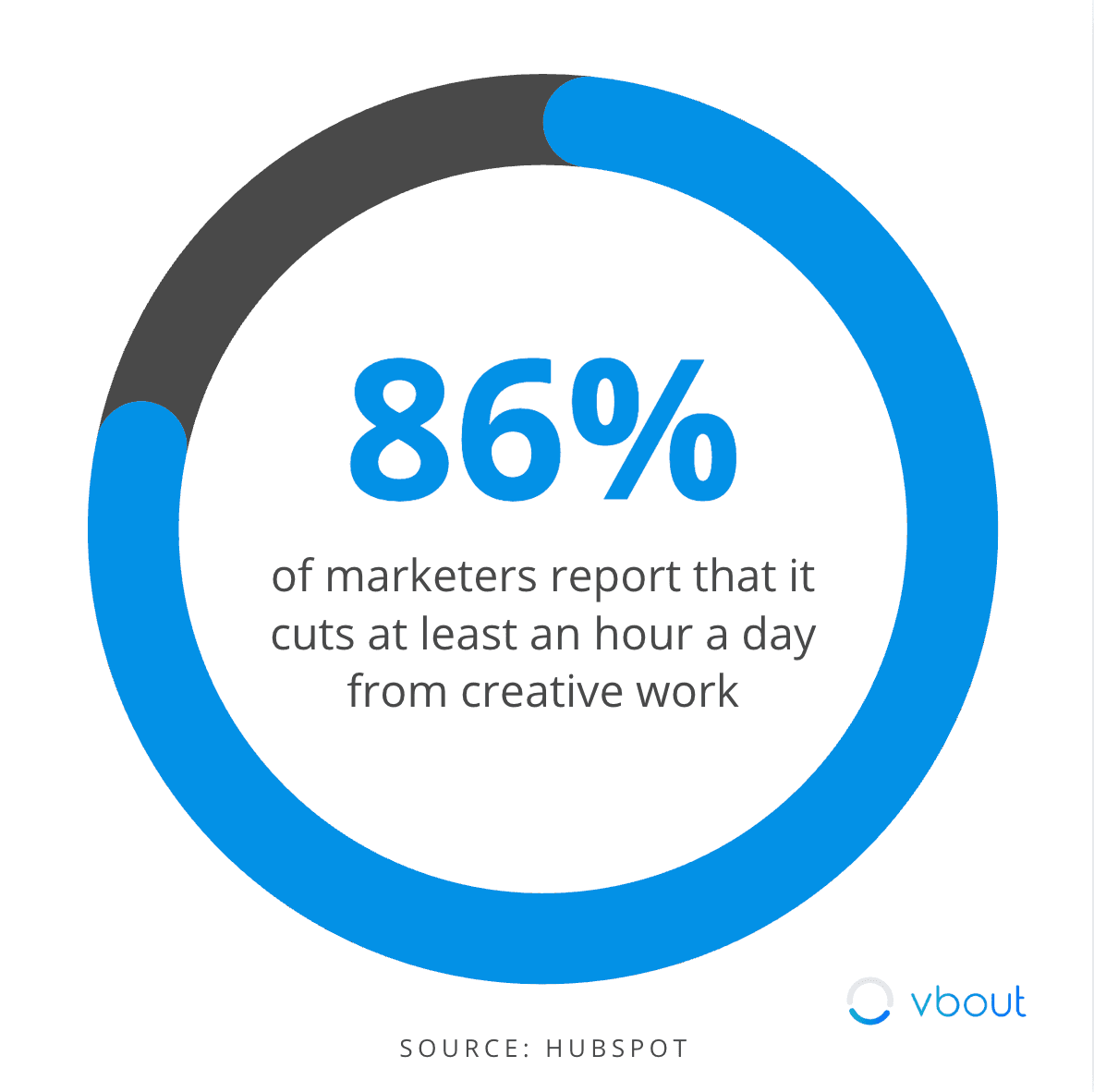
- Automate workflows and routine tasks: No more burning hours on manual scheduling, lead qualification, or reporting. 86% of marketers report it saves at least an hour a day on creative work, such as content creation or campaign brainstorming.
- Personalize at scale: AI extends beyond basic audience segmentation. It builds individual customer profiles that adapt in real time. This means your target audience receives automated email campaigns, offers, and recommendations that actually resonate. That’s why 56% of marketers list personalization at scale as a key reason for adoption.
- Optimize the customer journey: With predictive analytics, AI can forecast churn risk, purchase likelihood, or lifetime value. It then automatically adjusts campaigns to improve outcomes.
- Deliver insights and prove ROI: AI-powered data analysis transforms raw data into actionable recommendations. Teams gain visibility into what’s working and what’s not, while leadership gets the ROI proof they demand. As a result, 70% of marketers say AI gives them deeper insights, and over a third say it directly boosts ROI.

(Image by Ioana)
But how are SMBs putting AI to work?
Marketers are already leaning into AI in practical ways:
- 92% of brands use AI to personalize experiences and drive growth (automated email marketing and ads are a big part of this).
- 43% of marketers rely on AI-driven content tools for ideation and generation across email, ads, and social media.
- 26% of marketers use AI marketing automation to streamline and automate workflows.
- 80% of marketers use AI to save them time on repetitive tasks.
Teams are also using AI to:
- Optimize social media calendars with the best posting times and engagement analysis.
- Generate actionable analytics dashboards that improve decision-making.
- Build AI chatbots for round-the-clock customer service and lead capture.
- Improve positioning and targeting for better ad performance.
- Use social listening to spot trends and prevent PR crises.
- Identify and vet influencers for brand partnerships.
Here’s the bottom line.
AI helps move marketing from static, rules-based campaigns toward workflows that adjust based on customer behavior and performance data.
Key Categories of AI Marketing Tools for SMBs
There’s no shortage of AI marketing tools out there. But for SMBs, five categories stand out as the most impactful. 👇
Email Marketing and Automation
Email remains a workhorse for SMBs — and AI makes it smarter.
Tools like Mailchimp, Klaviyo, and Omnisend use machine learning to segment audiences, optimize send times, and personalize subject lines or product recommendations.
With AI, small businesses can:
- Recover abandoned carts with tailored follow-ups
- Trigger welcome sequences for new subscribers
- Suggest products based on customer behavior
These automations save time on email campaign production and deliver tailored experiences at scale.
That same logic can extend to rewards-based campaigns. SMBs running referral, loyalty, or win-back workflows can connect their marketing automation to a gift card API so that incentives are sent after a customer action rather than handled manually.
Chatbots and Conversational AI
Customers expect answers fast, whether it’s midday or midnight.
AI chatbots solve that by offering 24/7 customer support, automating FAQs, and qualifying leads directly on your website or social channels.

User-friendly options like Tidio Lyro or Manychat make it easy for SMBs to:
- Improve customer experience without adding headcount
- Guide visitors through booking or onboarding
- Capture leads outside business hours
- Provide multilingual customer support
Social Media Scheduling and Management
Keeping up with social media can drain a small team.
AI-powered social media management tools like Buffer, Hootsuite, and Sprout Social streamline the process by:
- Suggesting social media post ideas and captions
- Monitoring engagement and sentiment analysis
- Recommending optimal posting times
For SMBs, this means more scroll-stopping content with less guesswork. You can plan, schedule, and manage your entire social calendar from a single dashboard.
Advertising and Campaign Optimization
Running paid campaigns takes time and money. And SMBs don’t have much of either to waste.
AI-driven ad tools help by automating audience targeting, bid management, and creative testing.
Consider that marketers spend an average of 10 hours a week manually optimizing campaigns. (No wonder planned usage for ad bidding and mid-flight optimization has jumped 12% in the past year.)
AI-powered advertising solutions like Google Ads Performance Max, Meta Advantage+, and TikTok Smart Performance help SMBs:
- Test multiple ad creatives (banners, video, copy) without the manual overhead
- Refine targeting with AI-powered forecasting
- Stretch limited budgets further

Analytics and reporting
Data is everywhere, but SMBs rarely have time to analyze it properly. Thank goodness for AI-powered analytics tools.
Platforms like GA4, Supermetrics, Coupler.io, and Polar Analytics use predictive analytics, A/B testing, and attribution modeling to:
- Unify data from social media, ads, email, and websites
- Forecast outcomes like churn or purchase probability
- Automate reporting into clear dashboards
For payment-focused SMBs, this reporting layer matters because marketing data becomes more useful when it integrates with checkout and revenue data. Instead of only tracking clicks or opens, teams can compare campaigns against completed payments, repeat purchases, abandoned checkouts, and subscription activity.
With 64% of marketers saying AI helps them better understand customer needs, it’s no surprise 65% say they’re adopting AI to get more actionable insights. (For SMBs, AI creates a path to smarter decisions without needing a full-time analyst.)
How to Choose the Right AI Marketing Tools for Your SMB
With so many options, how do you know which AI tools are right for your business?
Here are some criteria to help guide your choices.
- Budget: Many platforms now bundle AI into existing tiers, but costs vary. Look for flexible pricing that fits a small or midsize business model.
- Ease of use: Pick tools that your team can learn quickly. A tool that requires constant troubleshooting and lots of training will just slow you down.
- Integrations: Make sure the tool connects to your CRM, email, or e-commerce platform so data flows seamlessly.
- Balance of automation vs control: Decide how much oversight you want. For example, Google’s Performance Max is powerful but limits transparency.
- Support: Quality customer support is crucial when adopting new technology. Support teams help you make sure you implement it properly and use its capabilities effectively.
Review G2 tool reviews and comparison guides, as well as Reddit comments, to see what real users have to say.
AI Tool Stacks for Common SMB Scenarios
Instead of adopting AI software as individual tools, SMBs get more value by combining them into a cohesive AI tool stack.
Here are three examples.
For eCommerce SMBs
An online store could combine:
- Email automation with Klaviyo or Omnisend for abandoned cart recovery
- AI ad optimization on Google and Meta to stretch limited ad budgets
- Analytics with Polar or GA4 to track conversions and lifetime value
- Chatbots like Tidio Lyro for 24/7 support
Together, this stack helps increase sales, recover lost revenue, and build long-term customer retention.
For Service-Based SMBs
Service-based businesses, such as salons, repair shops, or PR companies, thrive on efficiency and reputation. For example, in property management and real estate services, real estate workflow automation can help teams handle lead follow-ups, listing updates, document processing, tenant communication, and routine reporting with less manual work.
A strong stack might include:
- Social media scheduling with Buffer or Hootsuite to keep a steady presence
- Email workflows via Mailchimp or Constant Contact to nurture clients
- Chatbots for lead qualification and bookings
- Reporting tools to track campaign ROI
For example, courier services could use AI to:
- Trigger follow-up promotions after successful product drop-offs
- Manage customer inquiries through chatbots
- Personalize delivery updates
In doing this, service-based companies can boost customer satisfaction by streamlining workflows to deliver better end-to-end service.
For Agencies Working with SMB Clients
Every enterprise SEO agency needs scalability across multiple clients.
Their AI stack might include:
- Sprout Social or Hootsuite for publishing, listening, and cross-channel scheduling
- Ad platforms like TikTok Smart Performance for creative testing
- Supermetrics + Looker Studio for streamlined client reporting
- ActiveCampaign for multi-client email automation
This combination delivers clear insights to clients while saving the agency time on execution.
Setting Up for Success with AI Automation
AI isn’t plug-and-play magic. It still needs the right data, clear goals, and human oversight to perform well.
And if your customer data is messy or you don’t know what outcomes you’re aiming for, even the smartest AI models won’t deliver meaningful results.
That includes payment and customer data. Before adding more AI tools, SMBs should ensure their checkout, billing, CRM, and reporting systems can share clean data. Otherwise, automation may speed up campaigns without giving the business a clear view of what actually drives revenue.
To see results, SMBs should:
- Clean customer data to give AI models the quality inputs they need for accurate predictions and personalization.
- Monitor campaigns regularly to ensure AI adjustments align with objectives and stay on-brand.
- Train their team to reduce the learning curve and get value as quickly as possible.
- Set clear goals and KPIs to measure success and prove ROI. (Very important.)
- Start small and scale to test tool success before overhauling all workflows.
Conclusion
AI is rewriting the rules of marketing.
Scalability that once required large teams and budgets is now accessible to SMBs through AI marketing tools. They can automate emails, power chatbots, optimize social media, fine-tune advertising, and turn analytics into action.
And the shift is already happening.
Research shows that 63% of marketers are using generative AI today, with another 27% planning to adopt it in the next 6 months.
For SMBs, waiting too long to adopt AI risks falling behind competitors.
Ready to connect smarter marketing workflows with smoother payments? Explore Payline Data’s payment solutions to see how online payments, recurring billing, and reporting can support a more efficient customer experience.
Author bio:

Ioana Wilkinson
Ioana is a business strategist and content writer for B2B tech and SaaS brands. She also helps aspiring entrepreneurs build remote businesses. Born in Transylvania and raised in Texas, Ioana has been living the digital nomad life since 2016. When she’s not writing, you can catch her snorkeling, exploring, or enjoying a café con leche in Barcelona!